Follow the Filings, Not the Hype
Moneyta now lets you follow any stock or fund manager and hear only when the filings change, alerts you when tracked managers move in anything you hold, and with shadow books puts a manager's disclosed holdings, or a blend of several, beside your own portfolio. Built on our study of 312 managers, where only 16.7% beat the index.

Before you follow the smart money, you deserve the honest number. We replayed 312 of the largest managers' disclosed books at the real 45-day reporting delay over six years. Only 16.7% beat the index. The median book lagged it by 1.9% a year.
That number is why the features in this release look the way they do. We did not build a copy-trading button. We built the two tools the evidence supports: a way to hear when the filings actually change, and a way to see exactly how a manager's disclosed book differs from what you already own.
Both ship citing the study. Every manager you follow shows their measured record next to their moves, and every blend you build leads with the base rate before it shows you a single overlap number.
Follows: a watchlist that fires on filings
Follow a stock or a fund manager, and Moneyta notifies you when the filings change: a new quarterly holdings filing with its opens and exits measured against the immediately prior quarter, a large tracked institution moving in a stock you watch, or a company rewriting its risk factors in a 10-K or 10-Q. Never a price ping. Price alerts already exist, with thresholds you control; follows are for the slower, rarer signal that something on the record changed.
During filing season, thousands of managers file in the same week. You get one collapsed notification per night, in the app, with the detail one tap away. Email arrives once a week in the digest. Quiet is the design.
Shadow books: their book beside yours
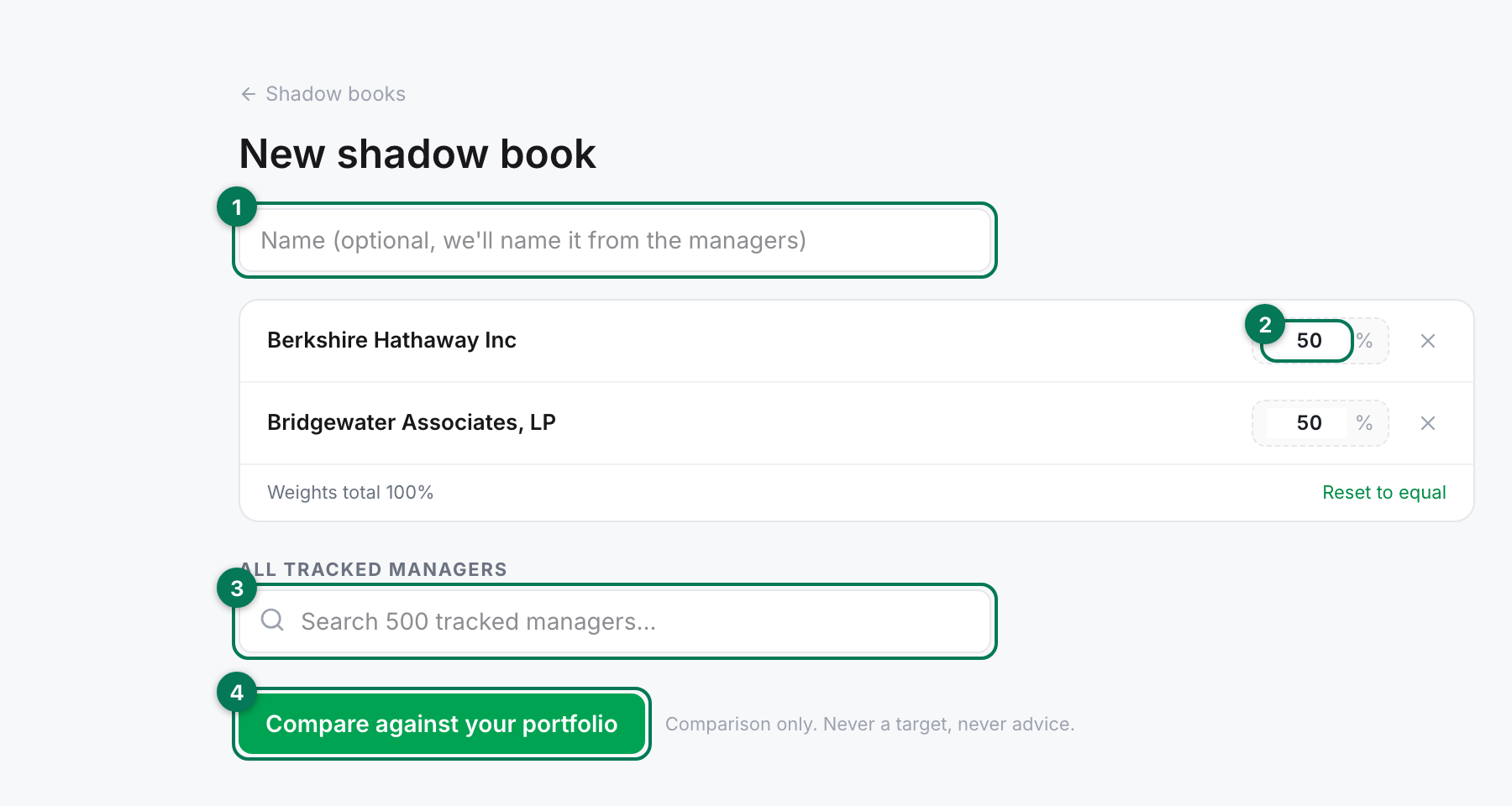
A shadow book takes a manager's disclosed long US equity positions, or a weighted blend of up to eight managers, and puts them beside your own equity sleeve: names in common, weight overlap, and the biggest tilts each way. Each component shows its own filing dates, its price coverage, and its individually measured track record.
The honesty rules are structural. If we cannot price 85% of a book's value, the comparison refuses to render and names the manager that fell short. A blend's headline number is the weighted average of its components' separate records, labeled as arithmetic, because a blend of disclosed books has no filing history of its own. And nothing ever becomes your target allocation: the comparison is an observation, not an instruction.
Whale alerts on everything you hold, no setup
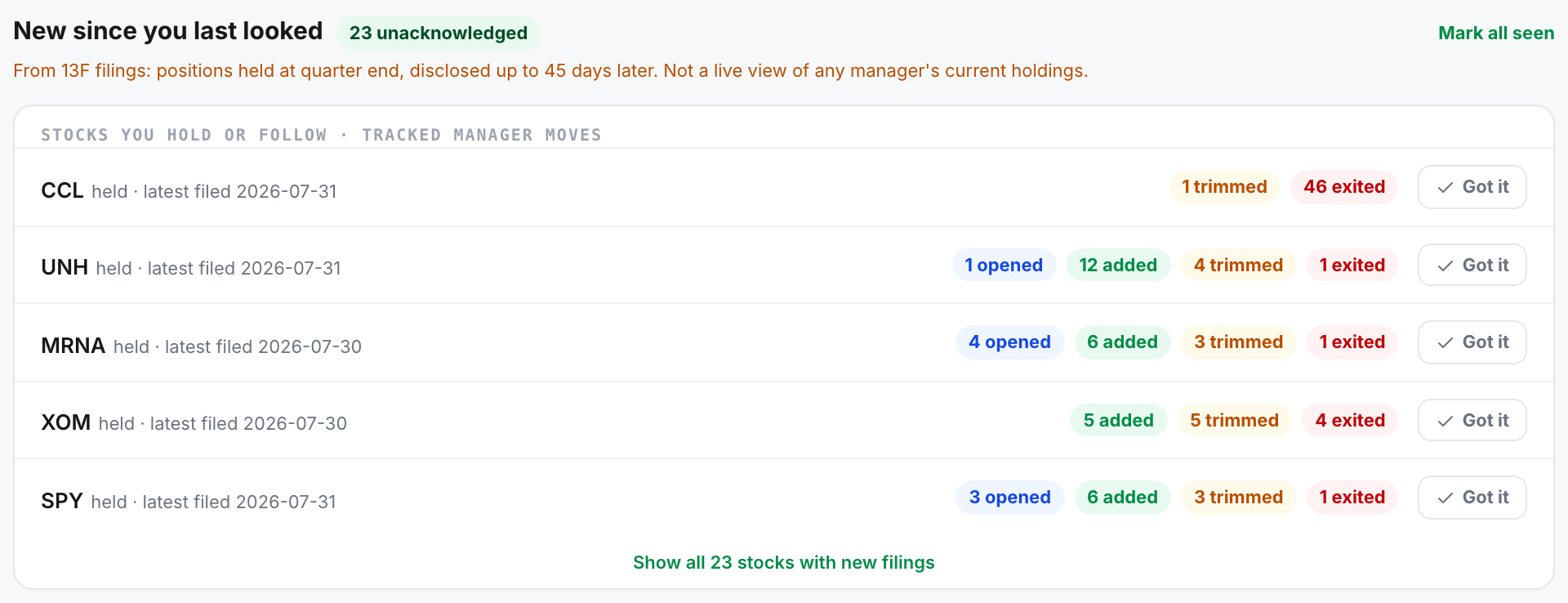
You should not have to follow a stock you already own. Every night, after the evening's SEC filings are processed, Moneyta checks whether tracked managers added, trimmed, opened or exited anything in your portfolio, and folds what it finds into that one nightly notification. Nothing to configure: if you hold it, you hear about it.
The research home carries the detail in a section called "New since you last looked." It works on acknowledgment, not on views: a row stays there, visit after visit, until you press Got it, and a later filing brings it back showing only what is new since you caught up. Glancing at a page never silently discards something you meant to return to.
The season ledger: honest numbers while the filings trickle in
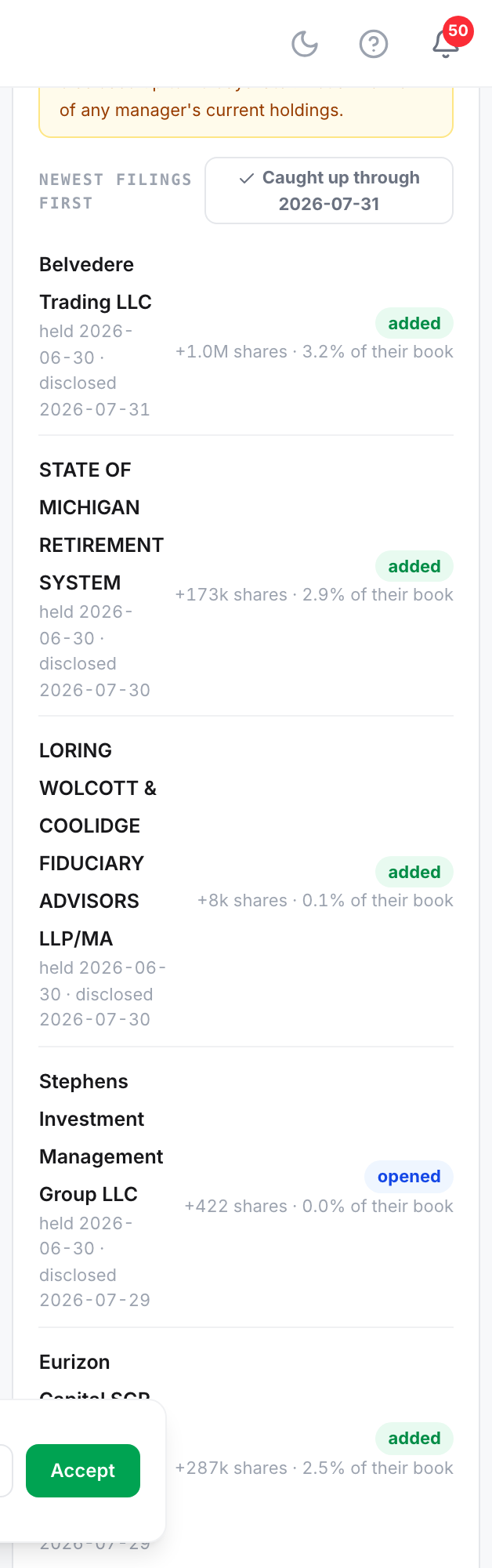
Managers file their quarterly holdings with the SEC on their own schedules across a 45 day window, so any mid-season count is arithmetic over whoever happens to have filed so far. Every stock page now carries a season ledger that says exactly that: who moved, newest filings first, with the denominator on screen. When it reads 67 of 500 tracked managers have filed, you know you are looking at 13 percent of the picture, and the page reminds you that large managers often file at the deadline, so early tallies over-represent small filers.
Each row shows what the manager actually did in share counts, not dollars, because a dollar change conflates the manager's decision with the market's price move. And each action sits beside the manager's own book weight: trimmed while still 4 percent of their book reads very differently from exited a position that was never material.
Every number explains itself
Both features carry a walkthrough. Tap How we calculated this and the math unfolds step by step with your own numbers in it: the trailing twelve months, the sleeve rescaling, the overlap sum. Standard formulas, nothing hidden that matters, nothing shown that misleads.
LearnWhat follows tell you (and what they never will)LearnHow shadow books work, and the four limits that keep them honestFrequently asked questions
Do follows send price alerts?
No. Follows fire only on filings: new quarterly holdings reports, institutional moves in a followed stock, and risk-factor changes. Price alerts are a separate feature with thresholds you control.
Is a shadow book a backtest of the blend?
No. Each manager's record was measured individually at the real filing delay. A blend shows the weighted average of those separate records, labeled as arithmetic, because the blend itself has no filing history.