
Test a Trade Before You Make It
Every trade changes your portfolio's structure, not just its contents. What-if simulation shows you the after picture (concentration, sector mix, Moneyta Score) before any money moves.

On the trading desks some of us came from, nobody put on a position without first knowing what it did to the book. Then we went home and managed our own money with none of that, buying on a hunch and finding out the consequences later. When you're about to buy a stock, the question you research is almost always "is this a good company?" The question that rarely gets asked: "what does this do to my portfolio?" Those are different questions, and the second one is the one nobody's tools answer before the money moves.
A stock can be a great business and a bad addition, because you already own too much of its sector, because it moves in lockstep with three things you hold, or because it would become an outsized share of your portfolio on day one. The trade doesn't happen in a vacuum; it happens in the middle of everything you already own.
Simulate the after picture
A what-if simulation takes a proposed trade and recomputes your portfolio's structure as if you'd already made it: Moneyta Score, concentration, sector weights, side by side with today. In the demo above, the proposed buy drops the Moneyta Score from 69 to 63, enough to slip from a B to a C. That cost is now visible before you commit, instead of a surprise you notice later.
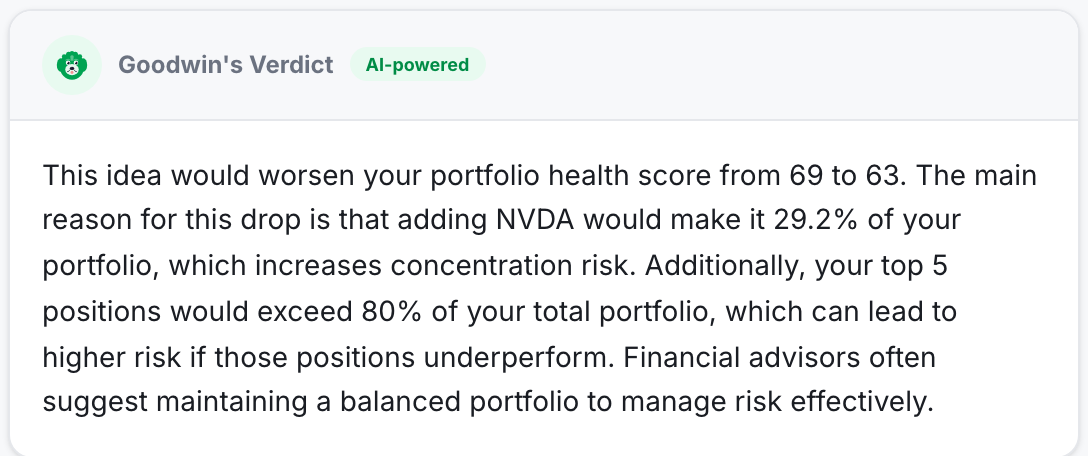
The explanation is the point. "Health -6" alone doesn't help you decide; knowing the trade would make a single stock 29.2% of your portfolio and push your top five holdings past 80% of its value does. You might make the trade anyway, and conviction is allowed, but you'd be doing it with eyes open.
Why the whole picture matters

This is how professional desks think about trades: not "do I like it" but "what does it do to the book." The math isn't exotic: it's the same portfolio arithmetic, run before the trade instead of discovered after. Retail investors have simply never had the tooling.
- Test the trade you're excited about: enthusiasm is exactly when a structural check is most useful.
- Test the sell side too: exiting a position changes your concentration and sector mix just as much as buying.
- If the simulation surprises you, that's the signal: it means your mental model of your portfolio and the real one have drifted apart.
Try a what-if on your own portfolio
Start free