Learn · walkthrough
Build a Shadow Book in Five Minutes
Published · 6 min read
A shadow book takes a fund manager's disclosed stock positions, or a weighted blend of up to eight managers, and puts them beside your own portfolio. It answers one question: how different is what they hold from what you hold? This walkthrough builds one from scratch. For the method behind the numbers and the limits that constrain it, read how shadow books work alongside this.
Step 1: start from a manager
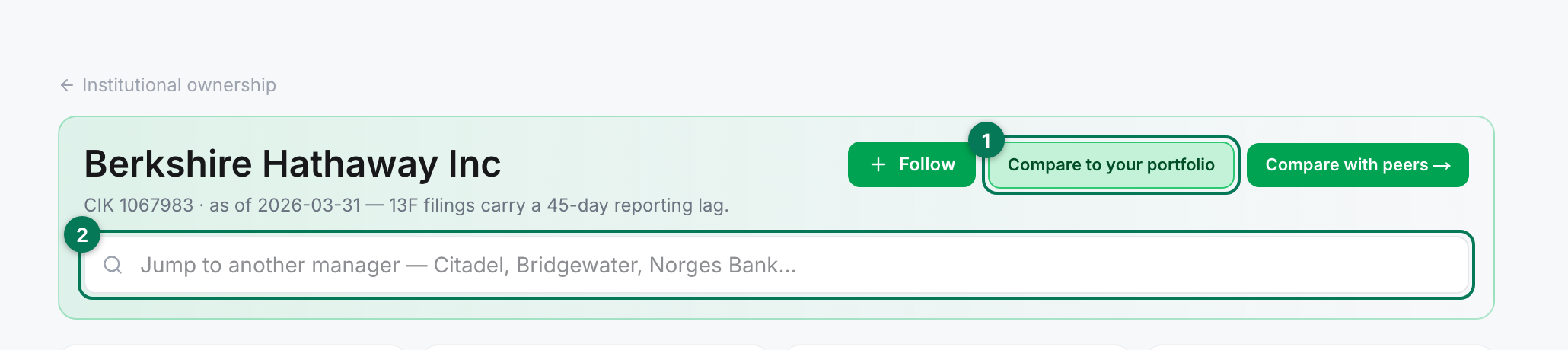
The quickest way in is from a manager you are already reading. Every fund manager page carries a Compare to your portfolio button (1) that opens the builder with that manager already in the blend. Use the jump box (2) to move between filers without leaving the page. You can also start empty from Portfolio → Shadow Books, or from any manager you follow in your follows list.
Step 2: build the blend
The name field (1) is optional. Leave it empty and the book names itself from the managers in it. Each manager carries a weight (2) that you can edit; weights start equal and re-equalize every time you add someone, and a running total tells you when they do not add to 100 percent. Search the tracked filers (3) to add more, up to eight. Then compare (4).
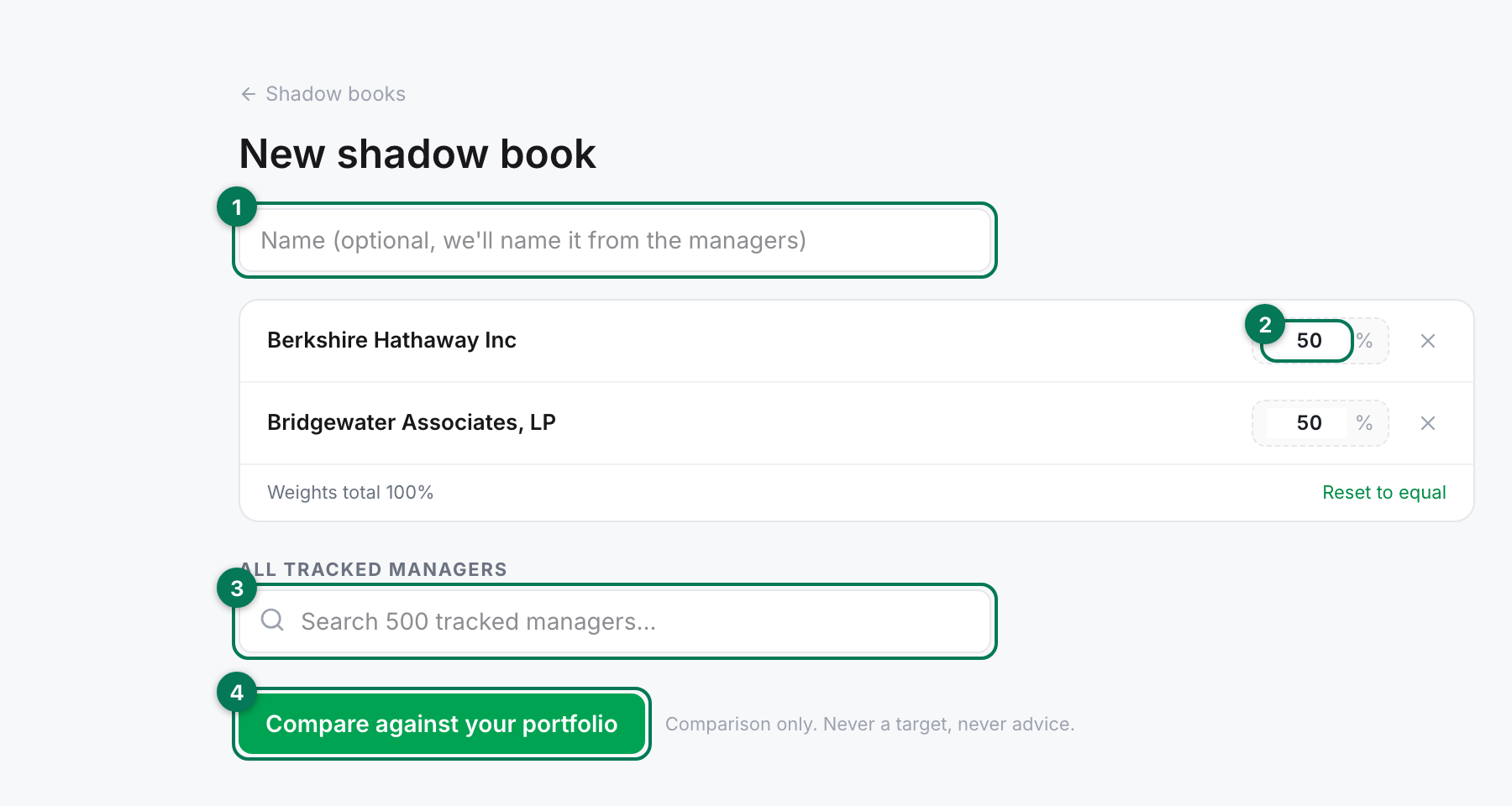
Two notes on picking managers. A blend of eight is not eight times the insight; past a handful of large managers you are approximating an index fund, which you can buy directly and more cheaply. And a manager whose book we cannot price well enough is still addable here on purpose, because the refusal further down names them. A builder that silently hid them would leave you wondering why a manager you wanted was missing.
Step 3: read the comparison
The order of this screen is deliberate. The managers in the book come first (1): each manager's own measured excess return against the S&P 500, the share of their holdings we can price today, and both dates that matter, the quarter they held it and the day they disclosed it. A manager we can't price well enough yet is still listed, with the largest holdings that have no price, and you can remove it from the book in one click. The blend's headline number sits under them, labeled (2) as weighted arithmetic over those separate records. It is not a backtest, because a blend you invented last week has no filing history to test.
Below that, overlap (3) counts the names you share and sums the smaller weight on each of them. The two tilt columns show where the blend leans harder than you (4) and where you lean harder than the blend (5), in percentage points.
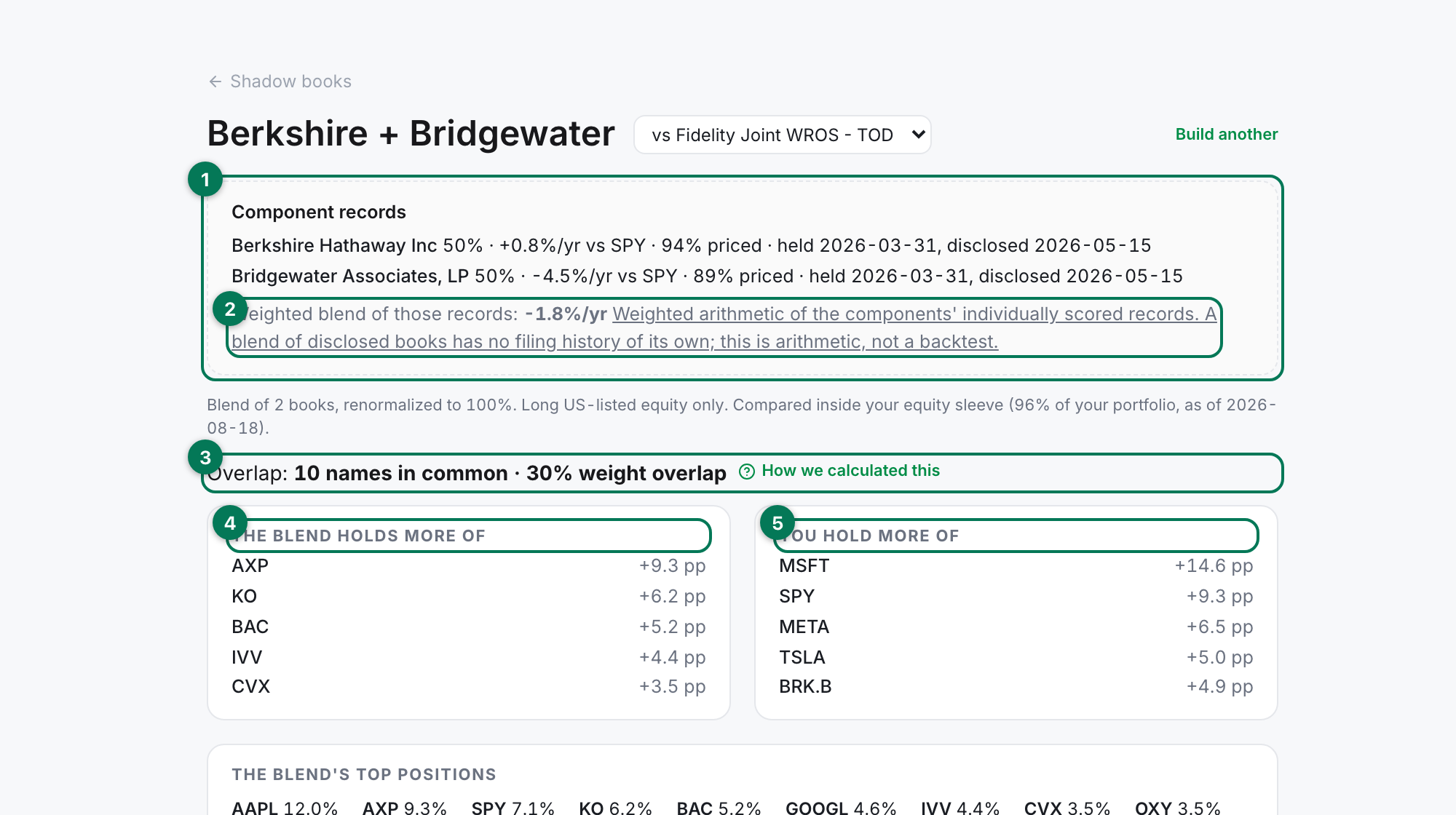
One line above the overlap does quiet but important work: the comparison runs inside your equity sleeve, renormalized to 100 percent. A disclosed book contains only the long US-listed stock reported in the filings. If you hold bonds, cash or crypto, comparing against your whole portfolio would report a difference that is really just your asset allocation. The sleeve line tells you how much of your portfolio the comparison actually covers.
Step 4: check the arithmetic
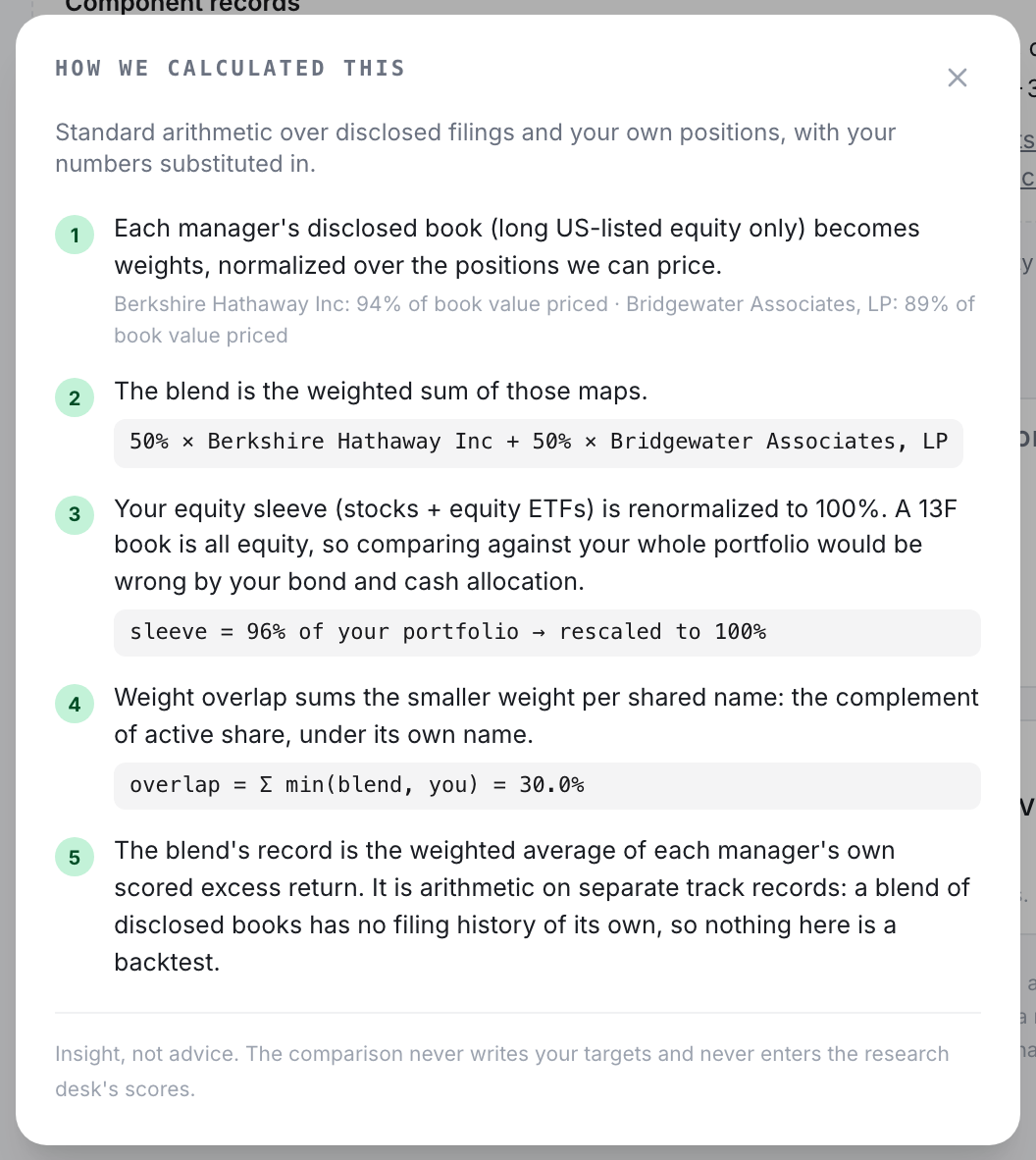
Every number here explains itself. How we calculated this opens the full walkthrough with your own figures substituted in: the coverage behind each manager's weights, the weighted sum that produced the blend, the sleeve rescaling, and the overlap sum. Standard arithmetic, shown rather than asserted.
What the comparison refuses to do
- It will not blend around a thin book. If any single manager falls below our pricing coverage floor, the whole comparison stops and names them, with their coverage. Remove that manager, or wait for coverage to improve. It never quietly renormalizes a partial book into a confident-looking one.
- It will not touch your targets. There is no adopt button. The blended weights table is copyable, and that is the whole of it. What you do with the observation is your decision, not a workflow we built for you.
- It will not present the blend as a strategy. The headline is arithmetic over records each manager earned separately, and it says so on the screen.
- It will not pretend the dates line up. Managers file on their own schedules, so components can carry different filing dates. Each one shows its own.
Worth holding onto while you read any shadow book: we replayed 312 of the largest managers at the real 45 day filing delay, and only 16.7 percent of them beat the index. Overlapping with a famous book is not evidence of anything by itself. The comparison is there to show you what is actually different, not to suggest the difference should be closed.
Educational information, not investment advice.