
Situational Awareness: The Blowup the Filings Could Not Show You
A fund reportedly returned 439% in half a year, grew its disclosed book fivefold, then liquidated its public positions in days. We walk through its four SEC filings: what they showed, when they showed it, and the risks those filings cannot carry.
In late July 2026, one of the fastest rises in hedge fund history reversed in days. Situational Awareness LP, the AI-thesis fund founded by former OpenAI researcher Leopold Aschenbrenner, had reportedly returned 439% net in the first half of 2026, with assets that CNBC reported approached $45 billion at the peak. Then semiconductor stocks fell, margin calls arrived, and the same reporting says the fund was forced to sell its entire public stock book at a discount, shrinking to roughly $10 billion.
This post is not gossip and it is not a victory lap. It is a walkthrough of the public record: the four quarterly holdings reports the fund filed with the SEC, what each one showed at the moment it arrived, and the specific risks those filings cannot show. If you follow fund managers through their filings, this is the clearest case study in years of what the paper trail can and cannot tell you.
The rise, as filed
The fund grew out of Aschenbrenner's 2024 essay series on AGI, launched in mid-2024 with reported backing from Stripe's Patrick and John Collison, Nat Friedman, and Daniel Gross, and reportedly started from about $225 million in seed capital. Its first holdings filing with the SEC covers the third quarter of 2025. From there, the as-filed totals tell the growth story on their own:
- Q3 2025, filed November 14, 2025: 28 positions, $4.14 billion in reported US securities.
- Q4 2025, filed February 11, 2026: 29 positions, $5.52 billion.
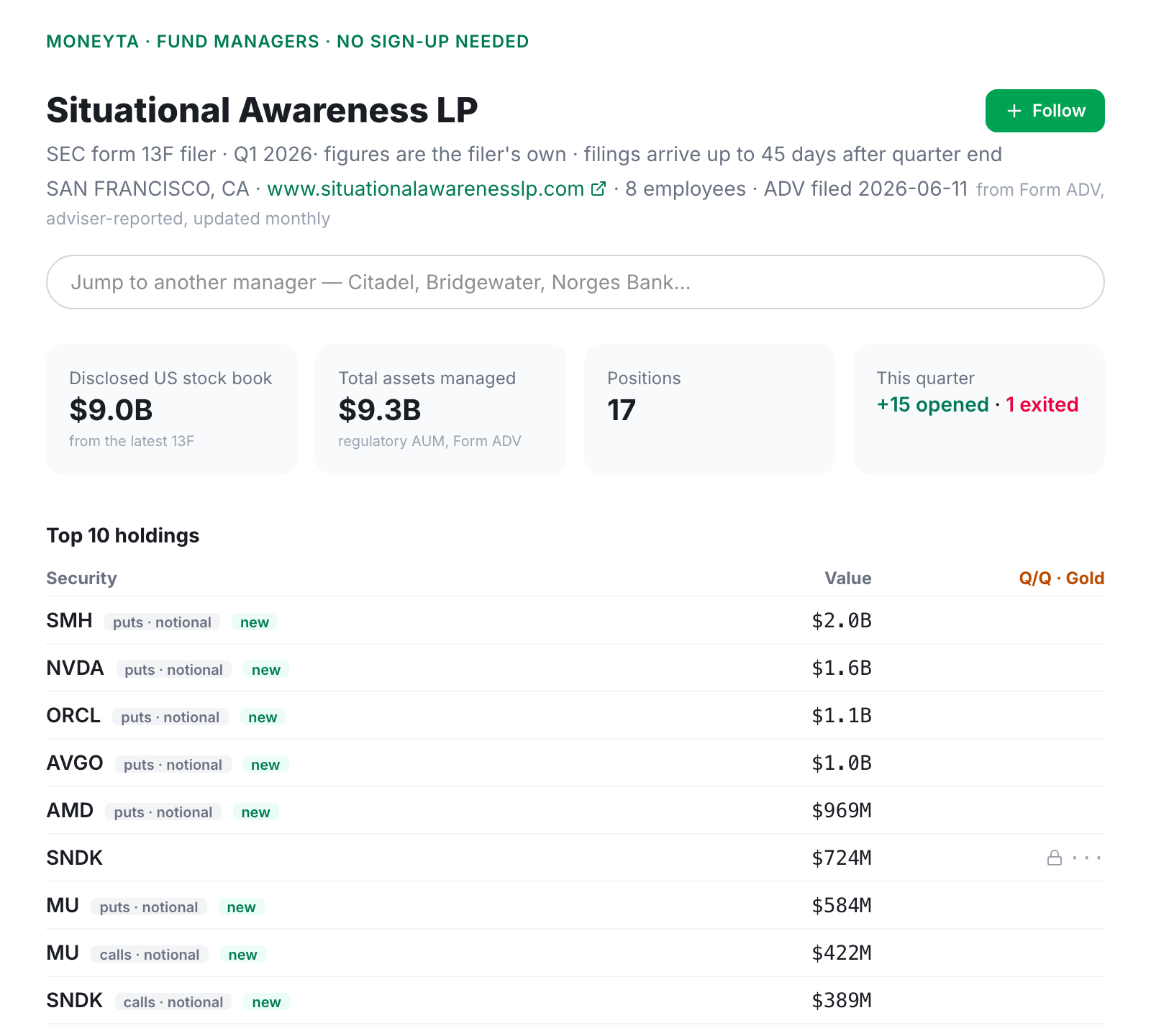
- Q1 2026, filed May 18, 2026: 42 positions, $13.68 billion.
- Q2 2026, filed August 14, 2026: 26 positions, $20.24 billion.
A disclosed book that grows fivefold in nine months is telling you something is compounding: returns, new money, leverage, or all three. The filings alone cannot say which. Press reporting later filled in the mix: returns above 1,000% since inception according to an investor letter cited by multiple outlets, and leverage that CNBC's sources put as high as 400%.
The quarter the hedges came off
The Q1 2026 filing is the most interesting document of the four, and it is the one on the fund's Moneyta page above. Alongside the long book, the fund reported put protection across the semiconductor complex: notional puts on NVIDIA, the SMH semiconductor ETF, Oracle, Broadcom, AMD and Intel, sitting next to call exposure on Micron and SanDisk. That is hedged concentration. Aggressive, but wearing a seatbelt.
Ninety days later the seatbelt was gone. The Q2 filing reports $20.17 billion of nearly pure long equity and only about $70 million in options. SanDisk, at $5.67 billion, and Micron, at $5.57 billion, made up 55% of the reported book between them.
What no filing could show
- Leverage. The filings report positions, not how they are financed. At the 400% leverage that reporting describes, a roughly 25% move against the book can consume its equity. Nothing in any filing hinted at the financing.
- Foreign listings. SK Hynix, which reporting names among the largest loss drivers, trades in Seoul. It never appears in these filings, which cover US-listed securities.
- Short positions. Reported shorts, including one commentators identified in Adobe, are invisible by design. The filings are long-only paper.
- Margin terms. The thing that actually forces a sale, the agreement with the lender, is in no public filing at all.
So a reader of the filings saw a large, concentrated, increasingly unhedged long book. What they could not see was that the same book was reportedly financed in a way that left it no room for a bad month.
The filing that described a ghost
The Q2 filing arrived on August 14, 2026, the legal deadline. By then, according to CNBC's reporting, the portfolio it described no longer existed: the fund had liquidated its public positions roughly two weeks earlier. Anyone who bought that book off the filing was buying a snapshot of a fund that had already left the building.
This is the 45-day delay problem in its purest form, and it is measurable. In our six-year replay of 312 large manager books at the real reporting delay, only 16.7% beat the index, and the failures cluster exactly here: fast-moving books whose filings are stale on arrival. A book that can be liquidated inside a quarter is the extreme case of a book that cannot be followed.
What to take from it
- Fame and returns are not followability. The honest question about any manager is whether their disclosed book was ever worth following at the delay, and that is a measurable question.
- The filing is a floor plan, not a stress test. No leverage, no shorts, no foreign lines, no financing terms. Treat it as a list of long US positions and nothing more.
- Hedges are information. Option rows appearing and then disappearing across quarters is one of the few risk signals the filings do carry. They carried this one.
- Extraordinary reported returns and extraordinary risk are usually the same fact stated twice. A 439% half-year and a forced liquidation are not two different funds. They are one book, described in two market regimes.
Every number in this post is either from SEC filings we store and can recompute, or attributed to the outlet that reported it. The fund's story is still being written, and its future filings will land on its Moneyta page like anyone else's. Historical statistics, not predictions. Insight, not advice.
Every new account starts with 14 days of Gold: every feature on, no card. Then Free, unless you choose a plan.
Frequently asked questions
What happened to Situational Awareness LP?
After a reported 439% net return in the first half of 2026 and assets that reporting placed near $45 billion, the fund was hit by falling semiconductor stocks and margin calls in late July 2026. CNBC reported it was forced to liquidate its entire public equity book, with assets falling to roughly $10 billion, followed by a reported pivot toward private positions.
Why did the fund's SEC filings not show the risk?
The quarterly holdings filing reports long US-listed positions only. It carries no leverage, no short positions, no foreign listings such as SK Hynix in Seoul, and no financing terms. The filings showed a large, concentrated book and, in Q1 2026, put protection that was gone by Q2. The forces that ended the fund lived entirely outside the form.