
The Fee You Never See
A fund's expense ratio never shows up as a charge: the fund takes it from its price, a little every day. Here is where it goes, what it adds up to, and how Moneyta now counts it from each fund's own filing with the SEC.
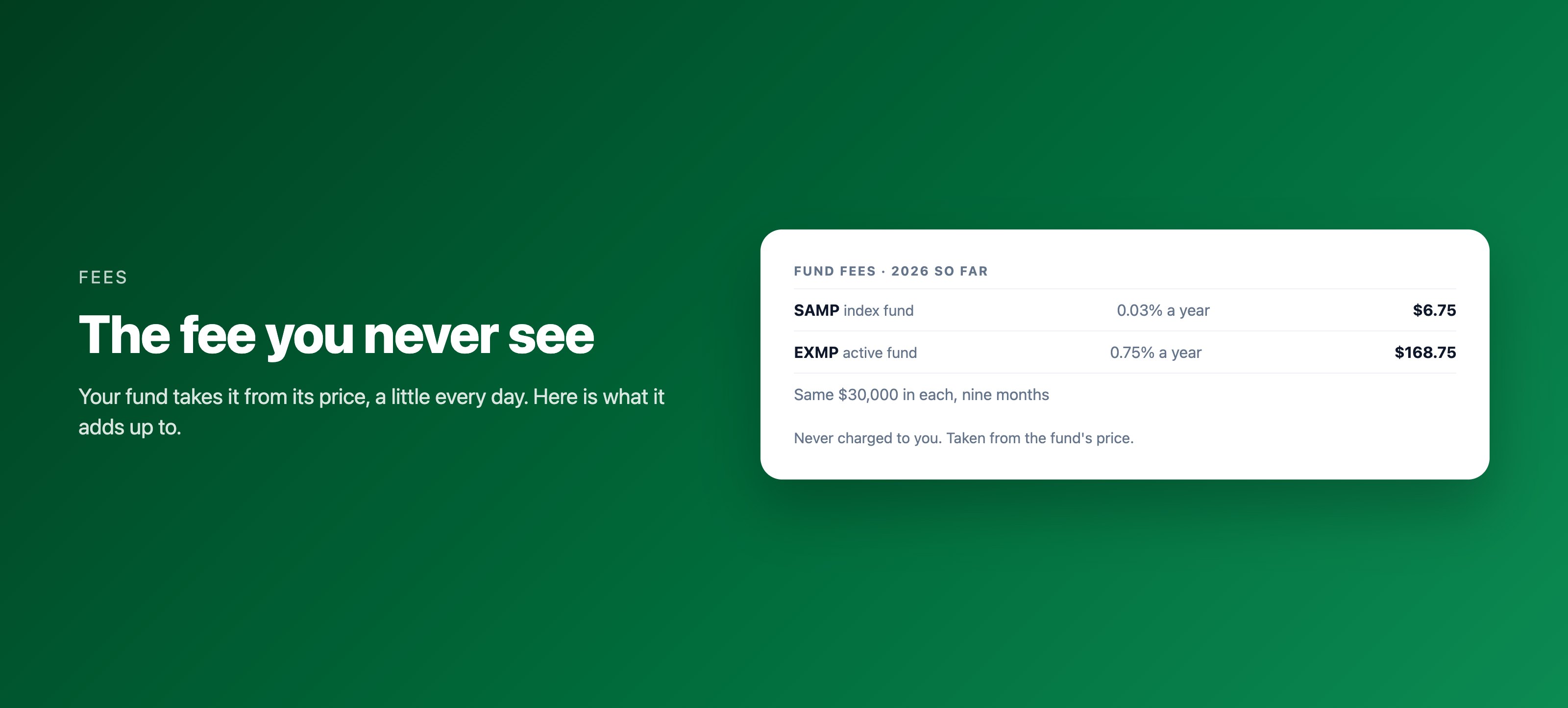
A member asked us this week where to find the small fee their funds charge. They had looked through every statement and never found it. That is not an oversight on their part: there is nothing to find. Of all the costs of investing, the expense ratio is the one designed never to appear as a line on a page.
Where the fee goes
A fund pays its managers, its custodian and its other running costs out of the money it holds. It accrues those costs every day, so each day's price is already a little lower than it would otherwise be. A fund with a 0.75% expense ratio gives up roughly 0.002% of its assets each day. You never pay it from your cash, and your broker never lists it, because it was never charged to you. It is simply part of the price.
What it adds up to
- $30,000 in a fund at 0.03% a year costs about $9 a year, or $6.75 over nine months.
- The same $30,000 in a fund at 0.75% a year costs about $225 a year, or $168.75 over nine months.
- The difference compounds: money taken in fees is money no longer invested, so the gap between two otherwise identical funds widens every year.
Those are synthetic numbers, chosen to be easy to check. Your own figures depend on what you hold, how much, and since when.
How Moneyta counts it
Every open-end fund files a fee table with the SEC in its prospectus, at least once a year. We read the expense ratio from that filing, keep the filing it came from, and keep each fund's history from 2025, so a fee change shows up on the date the fund filed it. For each month, we multiply the shares you held each day by the month-end price and the fee in force, then divide by 365. Each lot counts from the day you bought it and stops the day you sold it.
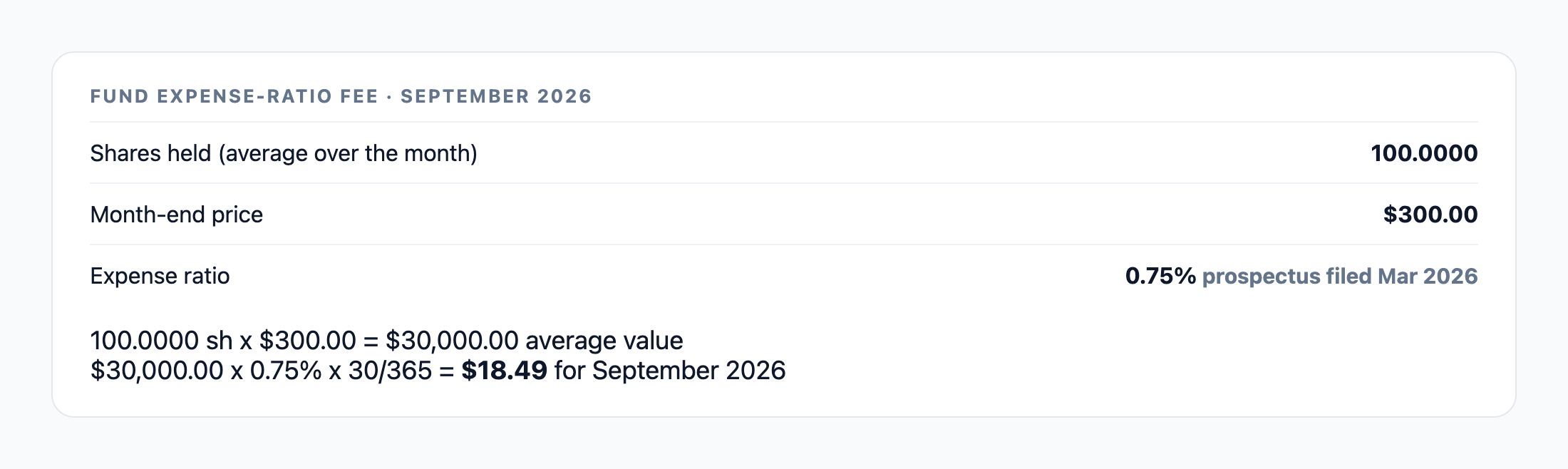
The result appears as Fund fees on your income statement and in your ledger, one entry per fund per month. Each fund holding also shows its estimated fees since you bought it, lot by lot.
Why it isn't counted twice
Because the fee is already inside the fund's price, any gain you make on the fund is already net of it. If we booked the fee as an ordinary expense, it would come off your results a second time, and your books would show cash leaving that never left. So the income statement shows Fund fees with an offsetting line beneath it, labelled as fees already in fund prices. You see what you paid; your cash and your net income stay true.
What we can't see yet
- Funds that don't file this fee table with the SEC, such as some commodity trusts and unit investment trusts. Where our team has entered the fund's published rate, we use it.
- 401(k) plan funds with internal codes that no market data provider recognises.
- Any other fund whose rate we don't have on record yet.
Your income statement names any fund it leaves out, and why, rather than quietly showing a smaller number.
How fees are scoredCost is the first step of the index-investor scoreFrequently asked questions
Why don't I see my ETF's expense ratio on my statement?
Because it is never charged to you. The fund deducts its expense ratio from its own assets a little every day, so it shows up only as a slightly lower price per share.
Is a fund's expense ratio tax deductible?
No. It is not a separate deductible expense and does not appear on a 1099; it is already reflected in the fund's returns.
Where does Moneyta get a fund's expense ratio?
From the fee table in the fund's own prospectus, as filed with the SEC, updated as the fund files new ones. Each value keeps the filing it came from.
How does Moneyta calculate a fund's fee each month?
Shares held each day x the month-end price x the expense ratio in force / 365. Each lot counts from the day it was bought and stops the day it was sold.