
The Index Investor's Checklist, Scored
Low costs, broad funds, an allocation you chose, and the patience to leave it alone. We turned that checklist into a free score with every weight published, so you can see exactly where your portfolio stands against it.
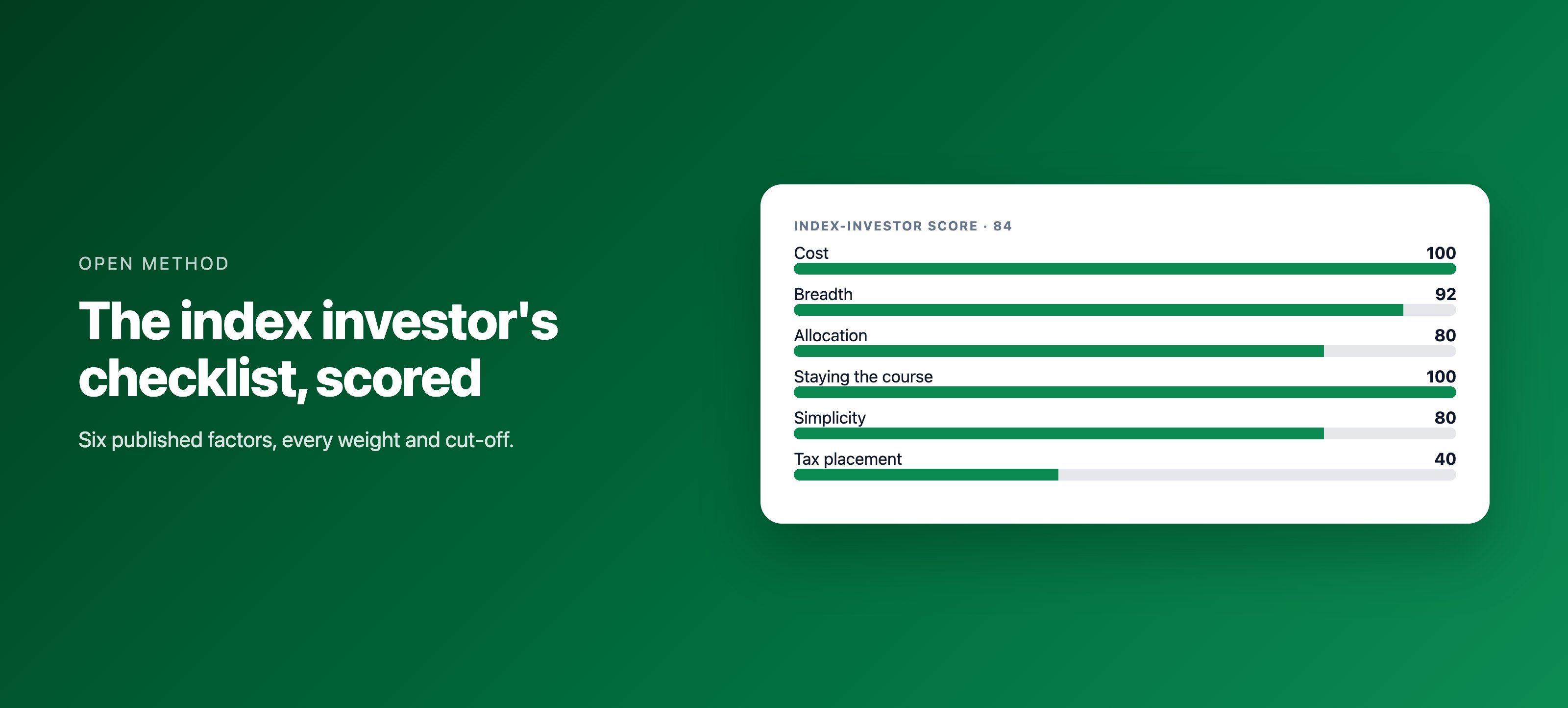
There is a well-worn checklist behind index investing, and most of it fits on an index card. Its strength is that almost none of it depends on predicting anything. So it makes a good yardstick: not a verdict on whether you will do well, but a check on whether your portfolio does what the approach asks.
The six factors and their weights
- Cost (25%): your funds' yearly fees, weighted by how much of your fund money each holds, and counted in proportion to how much of your money is in funds. 0.05% a year or less scores 100; 1.00% or more scores 0.
- Breadth (20%): the share of your money in index funds, and how many companies stand behind each dollar you hold.
- Allocation (20%): your bond share against your own saved target, or a rule of thumb from your optional birth year (with neither, the step doesn't apply).
- Staying the course (15%): how much you sold in the last 12 months, as a share of the portfolio.
- Simplicity (10%): how many funds you hold, less a deduction for overlap between them, also counted in proportion to your money in funds.
- Tax placement (10%): whether bonds and real estate funds sit in taxable accounts while stocks sit in tax-advantaged ones.
There is a seventh reading, the share of your stocks based outside the US, that we show and never score. The approach has no single right answer for it, so neither do we.
What happens when data is missing
A fund that reports no fee is left out of the cost factor, never assumed free. If we cannot see fees for 80% of your fund money, the cost factor says so instead of guessing. A portfolio with no funds at all has no cost factor. And when missing data would carry more than half of the factors that apply to you, the score refuses rather than hand you a number built on gaps.
See every step
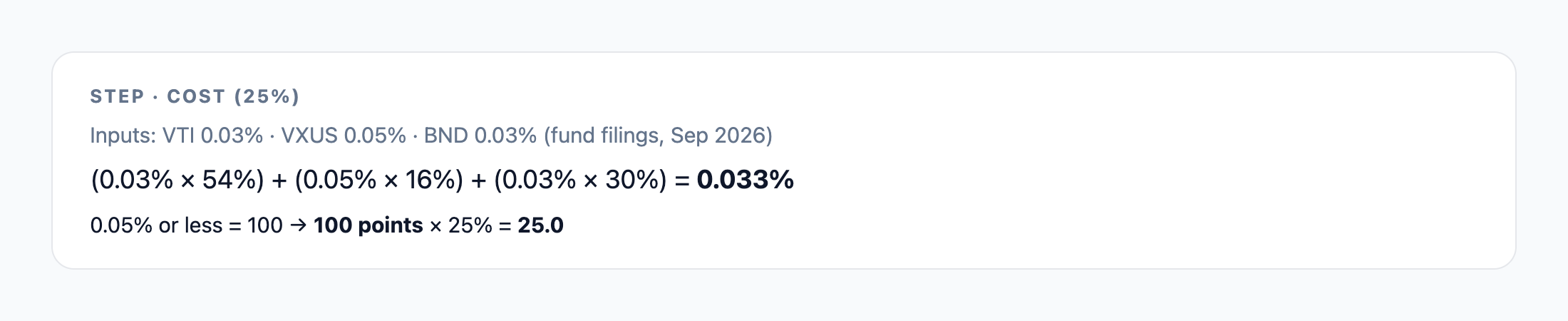
Open the score and it walks you through your own calculation: the inputs with their sources and dates, the formula with your numbers filled in, how that became points, its weight and what it added. You can download the whole calculation as a spreadsheet and check it yourself.
Inspired by the Bogleheads® investment philosophy. Moneyta is not affiliated with or endorsed by the John C. Bogle Center for Financial Literacy.
Frequently asked questions
What is the index-investor score?
A free Moneyta score from 0 to 100 that checks a portfolio against six published factors: cost, breadth, allocation, staying the course, simplicity and tax placement.
Does the index-investor score need my age?
No. It uses a saved target allocation first. An optional birth year is used only when there is no target; with neither, the allocation step doesn't apply and the other steps carry its weight.
Is the index-investor score free?
Yes, on every plan, including the full walkthrough and the downloadable calculation.
Is the index-investor score from the Bogleheads® community?
No. It is Moneyta's own score. Its checklist is inspired by the Bogleheads® investment philosophy (low costs, broad index funds, a chosen allocation, few trades, simplicity and tax-aware placement), measured with published weights. Moneyta is not affiliated with or endorsed by the John C. Bogle Center for Financial Literacy.