
The Insurance Gap Hiding in Your Net Worth
Most people can list what they own faster than what protects it. Why insurance belongs next to your assets, how renewal lapses actually happen, and how Moneyta's alerts catch a policy before it quietly expires.

Ask someone what they own and you'll get a confident answer: the house, the cars, the ring, the portfolio. Ask what protects it all and the confidence evaporates. Which policy covers the jewelry? What's the deductible on the house? When does the auto policy renew? For most households the answers live across three carrier portals, a stack of mail, and memory. That's the insurance gap: not necessarily missing coverage, but missing visibility into the coverage you're paying for.
Insurance belongs next to the assets
Moneyta tracks insurance the way it tracks everything else: as part of the picture. You can record homeowner and landlord policies, auto and other vehicle policies, coverage for your Vault valuables, umbrella policies, and anything else, each with its carrier, coverage amount, deductible, annual premium and renewal date. Policies link to the actual assets they cover, so the question "is this insured?" has an answer you can look up instead of an answer you have to reconstruct.
Because policy details are sensitive, they live in the Vault's encrypted tier: carrier, coverage amounts, deductibles and premiums are all sealed under your PIN-derived key. Only three fields stay readable by design: the coverage type, whether the policy is active, and the renewal date. That deliberate carve-out is what lets the reminder system below work even while your Vault is locked.
How coverage actually lapses
Almost nobody decides to let a policy lapse. It happens by mechanics: the renewal notice goes to an old email, the card on file expired, the carrier switched to paperless the same month you stopped reading that inbox. The result is discovering you were uninsured at the exact moment you need not to be. The fix is unglamorous: something that watches renewal dates and speaks up early.
That's what the renewal alert does. Thirty days before any active policy's renewal date, Moneyta nudges you: renewal coming, confirm it's handled. Not because renewing is hard, but because remembering is, and thirty days is enough runway to shop the premium instead of rubber-stamping it.
The gap-check for valuables
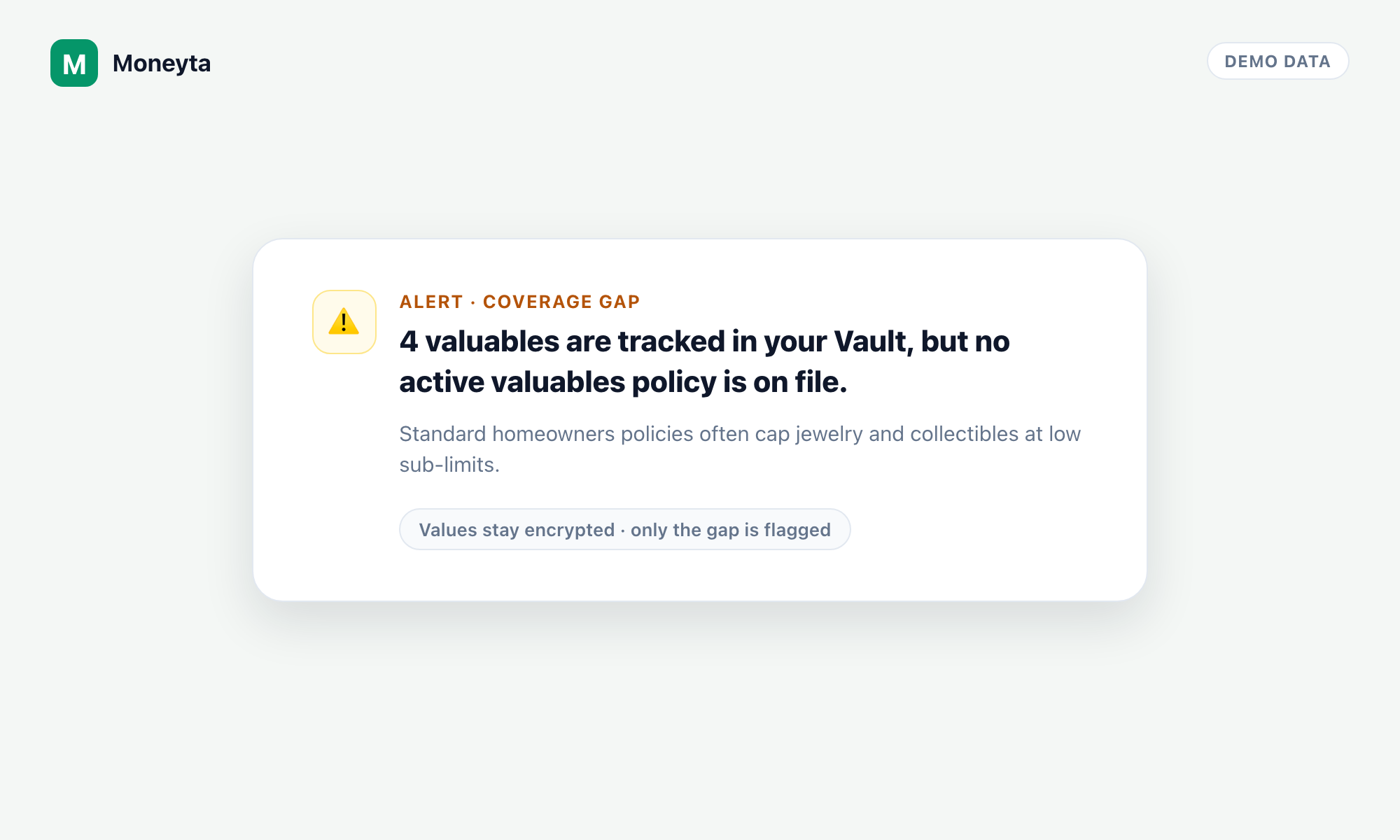
Renewals protect the policies you have. The second alert looks for the policy you don't: if you're tracking valuables in your Vault but there's no active valuables coverage on file, Moneyta flags it. Standard homeowners policies often cap jewelry and collectibles at surprisingly low sub-limits, so "the house is insured" and "the watch is insured" can be very different statements. The alert doesn't tell you what coverage to buy; it makes sure the gap is a decision instead of an oversight.
- Put every policy in one place, with its renewal date, the day you add the asset it covers.
- Treat a renewal notice as a decision point, not paperwork: it's the one time a year switching carriers costs you nothing.
- When you add something valuable, check the sub-limits on your existing policies before assuming it's covered.
Put your policies next to your assets
Start free