
Where Do You Keep the List of What You Own?
Everyone has the list: the jewelry, the watches, the appraisals, the policy numbers. Most people keep it in a spreadsheet, a notebook, or a file named something clever. We compared those honestly against an encrypted vault, trade-offs included.

Almost everyone who owns anything valuable has the list somewhere: the jewelry and what it appraised for, the watches, the coins, grandma's ring and the story that comes with it, the policy numbers that cover it all. When we asked friends where their list lives, we got three answers over and over: a spreadsheet, a notebook in a drawer, or a file on the computer named something clever like "recipes_backup_2". Each of those is a real solution with real strengths, so let's compare them honestly, including against our own Vault, trade-offs and all.
The spreadsheet
A spreadsheet is flexible, free, and you already know how to use it. You can add columns for anything, sort by value, and total it up. For pure record-keeping it's genuinely hard to beat. The problems start with everything around the file.
- It's usually unencrypted, and it syncs: the moment it touches a cloud drive or an email attachment, copies exist in places you don't control and can't enumerate.
- It never reminds you of anything. The appraisal from 2019 sits there aging, and the sheet will not tell you it's stale.
- It's disconnected from your money. The total at the bottom never meets your portfolio, so your real net worth lives in your head.
- Sheet passwords protect against a casual glance, not against anyone determined; spreadsheet password protection is famously weak.
The notebook in the drawer
Handwritten notes have underrated virtues: they work offline, they can't be hacked from another continent, and writing things down makes you think about them. For some people that ritual is the whole point. But paper fails in ways that are permanent.
- There is no backup. Fire, flood, a move gone wrong, and the record of everything you own is gone at exactly the moment you need it for a claim.
- It goes stale silently. Nothing nudges you to update a value or re-appraise, so the notebook describes the collection you had years ago.
- Nobody else can find it, including the people who might one day need to. A list no one can locate is not much better than no list.
- Anyone who does find it can read every word. Paper has no PIN.
The secret file on your computer
The cleverly named file is the digital notebook: convenient, private-feeling, and instantly searchable. It also inherits the worst of both worlds. If it's unencrypted, it's readable by any person or program that reaches the machine. If you encrypt it yourself, you've signed up to be your own key-management department, and the file with a password you set five years ago is a coin flip you'll ever open again. Meanwhile backups quietly multiply copies of it onto external drives and cloud folders you've stopped thinking about.
What a purpose-built vault changes
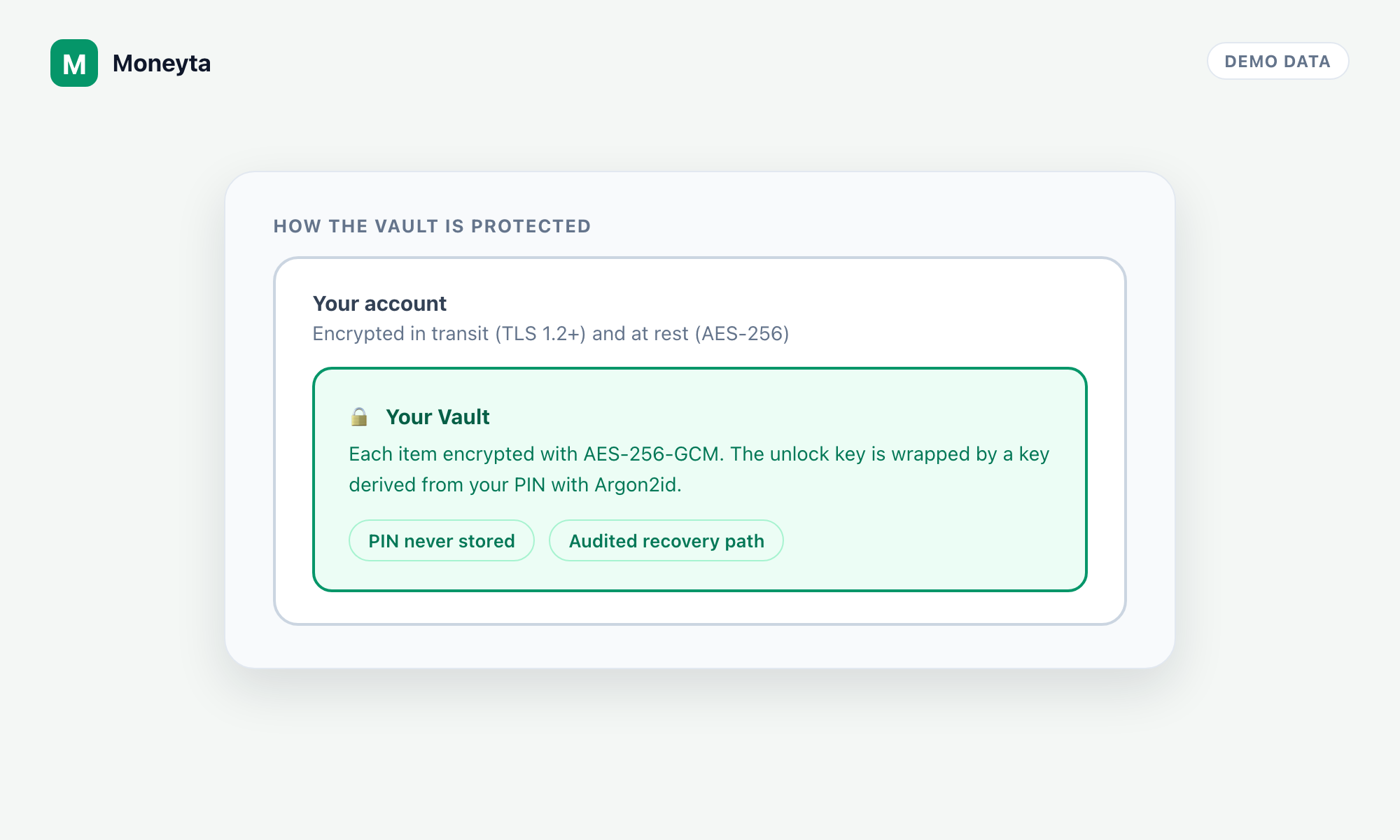
Moneyta's Vault is a PIN-encrypted home for exactly this list. Each item is encrypted with AES-256-GCM, and the key that unlocks your items is wrapped by another key derived from your PIN with Argon2id, a modern password-hardening algorithm. Your PIN is never stored, so a locked Vault can't be read out of our database. Around the encryption sit the things a file can never do for you.
- Reminders are built in: appraisal-cadence alerts when a professional appraisal is getting old, and staleness alerts when a value you entered hasn't been refreshed in a year.
- Precious metals get live melt-math, so the gold in the drawer is valued by weight and purity instead of a guess from 2020.
- Insurance lives next to the items: link policies to what they cover, and Moneyta flags valuables that have no active coverage at all.
- Your valuables roll into your net worth alongside your portfolio, real estate and vehicles, one number instead of a scattered mental sum.
- Alert emails about your Vault deliberately contain no dollar amounts. The nudge reaches your inbox; the values stay sealed.
The honest trade-offs
No option is free of trade-offs, ours included, so here are the Vault's plainly. You're trusting a hosted service rather than a drawer you can touch. If you forget your PIN there's an audited, email-verified recovery path, which is also why the Vault is not fully zero-knowledge: we chose recoverable-with-audit-trails over unrecoverable-forever, and we say so rather than overclaim. And valuables only count toward your net worth while your Vault is unlocked, which is the privacy design working as intended, but it can surprise you the first time.
Give the list a safer home
Start free