
Your Home Is Probably Your Biggest Position. Track It Like One.
For most households the home is the largest single asset they own, and the least tracked. How Moneyta turns a house and its mortgage into equity you can see, and how alerts keep the numbers from quietly going stale.

Some of us spent careers building systems that tracked every position a fund held, marked to market, reconciled daily. Then we'd go home to households where the single largest asset, the house, lived in no system at all: a purchase price from years ago, a mortgage balance nobody had looked up since closing, and a guess. If a fund managed its biggest position that way, someone would be fired. For the rest of us it's just normal.
A house is two numbers, and you own the difference
In Moneyta a property is what it is on a balance sheet: the estimated value on one side, the mortgage on the other. You enter the property with what you believe it's worth today, add the mortgage with its lender, balance, rate and payment, and Moneyta derives the two numbers that matter: your equity, which rolls into your net worth alongside your portfolio, and your loan-to-value ratio, which tells you how leveraged that equity is. Multiple properties, second homes and rentals all work the same way, in any currency.
We made a deliberate choice here: you enter the value. There's no scraped estimate of your home changing your net worth while you sleep. You know your street, your renovation, your market better than a model that's never seen your kitchen. The cost of that honesty is that the number is only as fresh as your last update, which is exactly why the alerts below exist.
Property values rot quietly
A portfolio reprices itself every trading day. A house does not. The value you entered eighteen months ago just sits there, silently wrong in whichever direction your market moved, and every number built on it, your equity, your LTV, your net worth, inherits the error. The same rot applies to the mortgage: the balance shrinks with every payment, but only if something records it.
Alerts do the remembering
This is where Moneyta behaves like the systems we used to build: it watches the data so you don't have to. Real estate gets its own set of alerts, each of them observational. They tell you what changed or what's gone stale; what to do about it stays your call.
- A monthly nudge to glance at a property's value and confirm it still looks right. Thirty seconds, once a month.
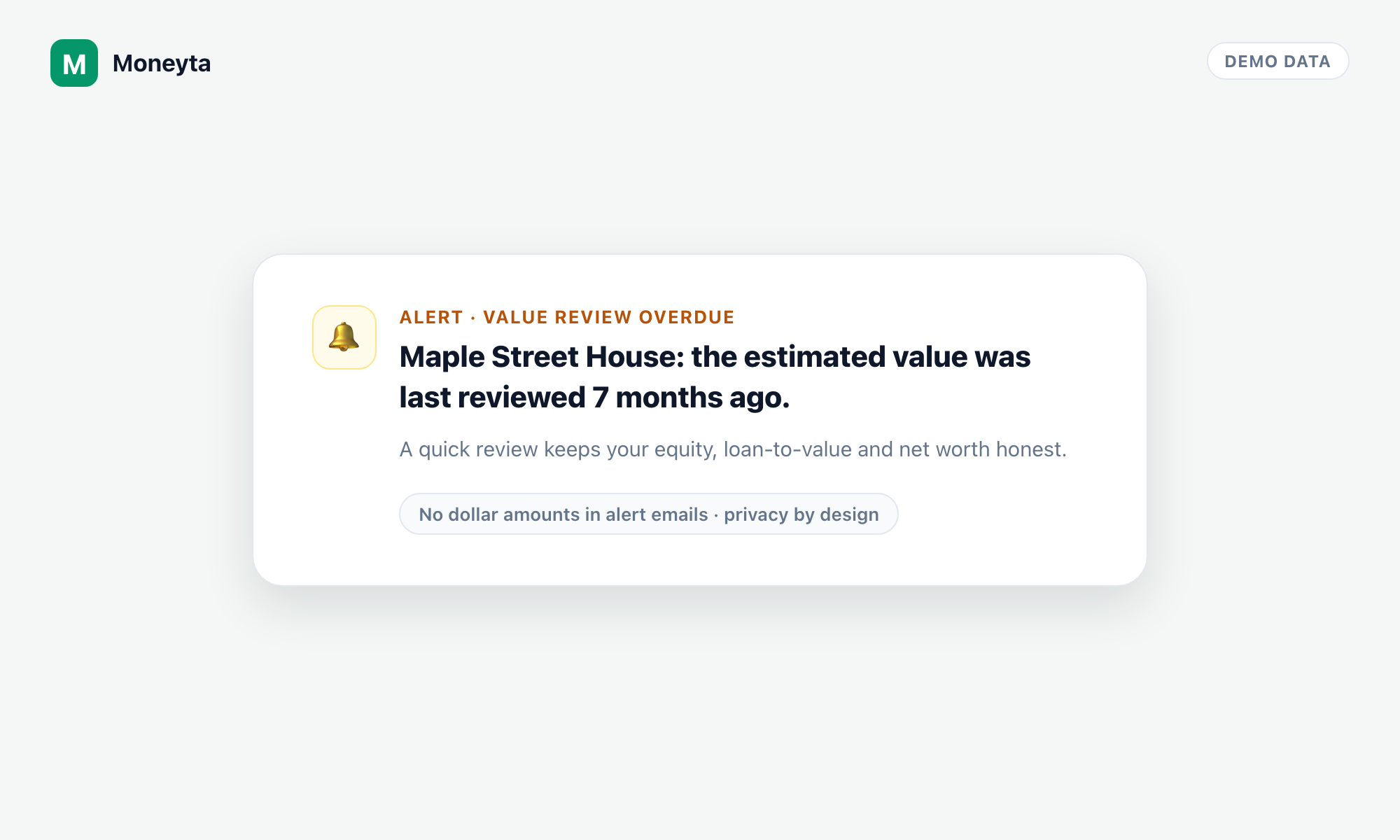
- A staleness alert when an estimated value hasn't been reviewed in six months, and another when a mortgage balance hasn't been updated in three.
- An equity-change alert when a value or balance update moves a property's equity by ten percent or more, so a big swing never slips by unnoticed.
- A loan-to-value alert when LTV crosses eighty percent, the threshold lenders themselves care about.
- An insurance renewal alert thirty days before a property policy lapses.
The house has a P&L too
Owning property is also a stream of expenses: property tax, insurance, maintenance, HOA dues, utilities, management fees. Moneyta's activity feed logs each of them against the property, and the year-end report totals what the house actually cost you this year. If you've ever wondered whether the rental is really cash-flow positive, or what homeownership costs beyond the mortgage, that's a question your own ledger can answer.
Put your biggest position on the books
Start free