
The Books Professionals Keep, Now Running Under Your Portfolio
Funds don't trust a screen, they trust their books: every event recorded twice, totals that must agree, history that can't quietly change. Moneyta runs that same double-entry discipline under your own money. Here's what that means in plain English.

Some of us spent our careers building the systems that keep a professional fund's books. Here's the thing nobody outside those walls quite believes: the traders don't trust the trading screen. Nobody does. What everyone trusts is the books, a separate, disciplined record where every event is written down the same careful way, checked nightly, and reconciled against the outside world. Screens can be wrong. Books have to balance. When we built Moneyta, we gave your money the same treatment.
Double entry, without the accounting course
The technique is centuries old and the idea fits in a sentence: every money event gets recorded twice, once for what happened and once for why. VTI pays you a $182 dividend? Your cash went up $182, and dividend income of $182 explains where it came from. You buy shares? Cash goes down, the position goes up, same amount. Because both sides of every event are written down, the totals across your entire history must agree to the penny. If they ever don't, something is wrong, and the books themselves tell you so.
That self-checking property is the whole point. A single-column record, like a spreadsheet of transactions, can absorb a typo silently and carry it forever. A double-entry record can't: an error unbalances the books and gets caught. It's the difference between a diary and an instrument.
Nothing is ever quietly rewritten
The second discipline funds insist on: history is append-only. In Moneyta, every trade, dividend, fee and expense posts to the ledger and stays there. Corrections are recorded as new entries, on the record, next to what they correct. Nothing is ever edited in place or silently deleted. Six months from now you can look at any number and see exactly how it got there, which is precisely the property a spreadsheet loses the third time you fix a cell and forget you did.
The statements fall out for free
Once every event is posted properly, the reports businesses run become automatic for your household: a balance sheet (what you own and owe), an income statement (what came in and went out), and a cash-flow view, all generated from your own postings rather than assembled by hand. No end-of-year archaeology, no reconstructing the past from statements.
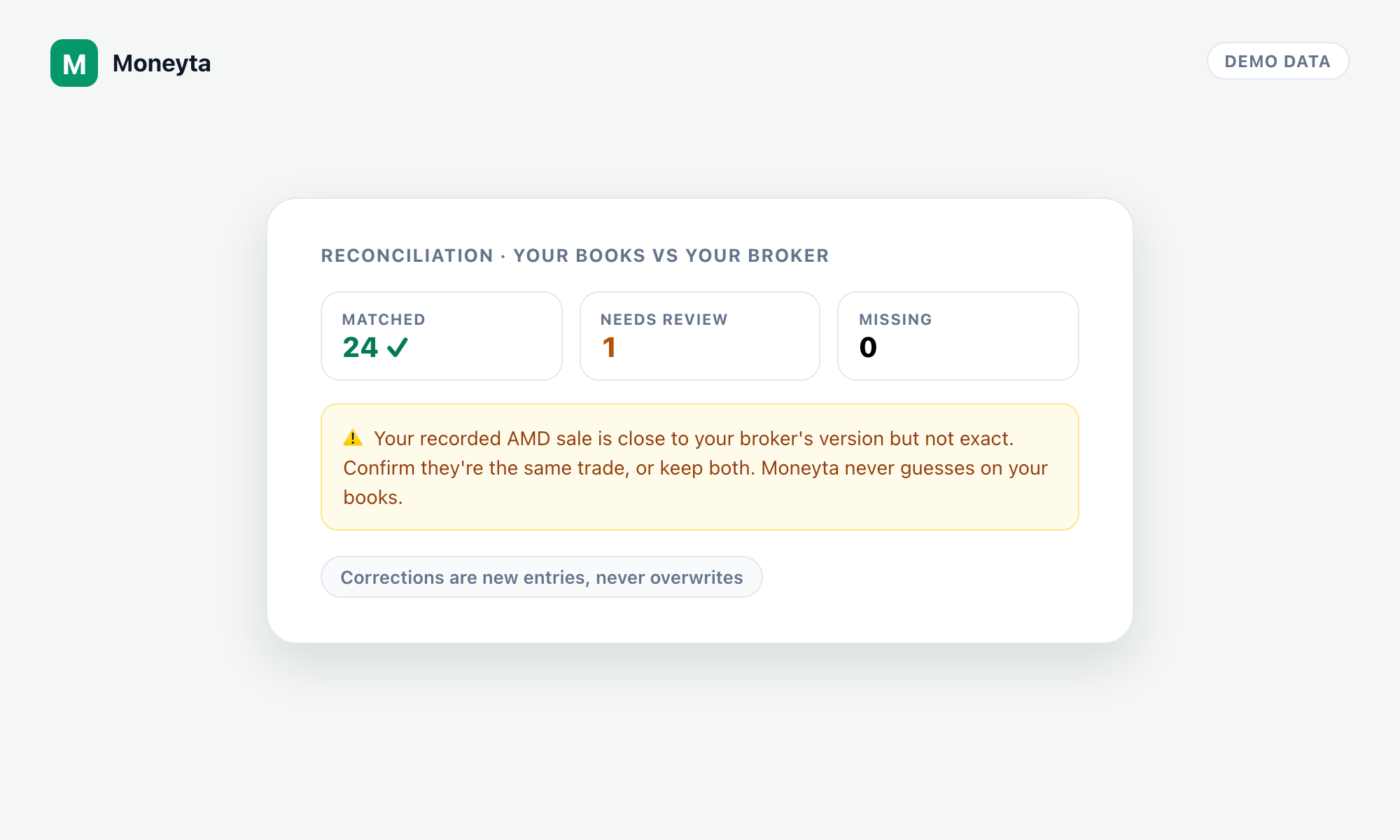
And the books check themselves against your broker
Keeping your own record only matters if it matches reality. If your broker is connected, Moneyta reconciles your books against your broker's version: exact matches confirm automatically, near-matches are surfaced for you to confirm, and anything missing is named. On top of that, a nightly job re-verifies that the whole ledger still balances. That's not a feature we advertise so much as a habit we brought with us: books you don't verify are just hopeful notes.
- Every money event is recorded on two sides, so your history is self-checking rather than hopeful.
- Corrections add entries, never rewrite them. What you see today is what you'll see in five years.
- Balance sheet, income statement and cash flow are generated from your own postings, not rebuilt by hand.
- Reconciliation against your broker plus a nightly balance check keep the books honest without you doing anything.
Give your money real books
Start free