
How to Vet a Financial Adviser: Trust Your Gut, Then Verify It Against Their Own SEC Filing
How do you check a financial adviser before you sign? Every SEC-registered investment adviser answers a questionnaire about itself on Form ADV: who it serves, how it is paid, whether it holds client money, whether a broker-dealer or insurance arm sits under the same roof, and whether any disciplinary or regulatory events are on the record. Moneyta's new adviser screener turns those answers into filters, free and with no sign-up. Trust your gut about the person. Verify the firm in five minutes.
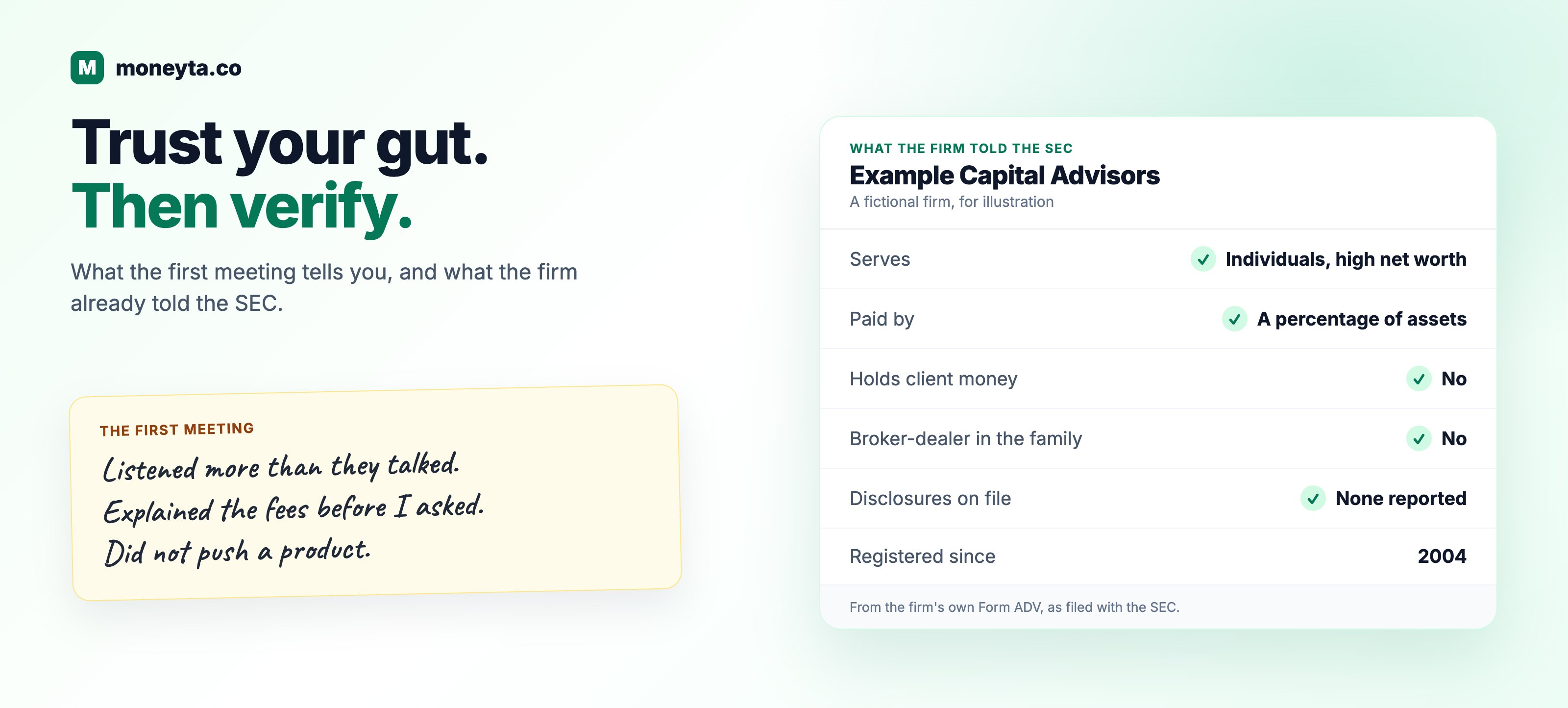
Trust your gut about the person
Most people choose an adviser the way they choose a doctor: a referral, a first meeting, a feeling. We are not going to tell you that is wrong. The things a gut reads well are real signals, and no filing captures them. Did they listen more than they talked? Did they explain their fees before you asked? Did a product come up in the first twenty minutes? You will know the answers by the time the coffee is cold, and you are right to weigh them.
What a gut cannot read is the firm. It cannot tell you whether the firm is paid by commissions as well as by fees, whether it holds client money itself, whether there is a broker-dealer or an insurance business under the same roof, or whether anything has ever been reported against it. Those are not personality questions. They are facts, and the firm has already written them down.
One thing to settle first: who is the adviser? The person you met may be a representative of a firm with hundreds of people, or a one-person practice that is itself the registered firm. Either way, the entity registered with the SEC is a firm, and it is the firm that files Form ADV. A solo practitioner files one too. The individual also has a record of their own on the SEC's adviser site, with their registrations, employment history and any disclosures, which is worth reading alongside the firm's. Everything below is about the firm, because that is where the fees, the custody and the business under the roof are written down.
What every adviser tells the SEC, in its own words
An investment adviser registered with the SEC files a form called Form ADV and updates it at least once a year. Part 1 is a questionnaire about the firm: who it serves, how it is paid, what services it offers, how much it manages, whether it has custody of client assets, what other businesses it is in, and a section of yes-or-no questions about criminal, regulatory and civil events, the part the industry calls disclosures. Part 2 is a brochure written in plain English, and a short relationship summary called Form CRS. All of it is public on the SEC's adviser site, one firm at a time.
The trouble is the one firm at a time. Reading a Form ADV is like reading a tax return: everything is there, and nothing is easy to find. If you want to compare three firms on the same six questions, you are opening three forms and hunting for the same boxes in each. Most people do not, and that is the gap we wanted to close.
The adviser screener: the questionnaire, turned into filters
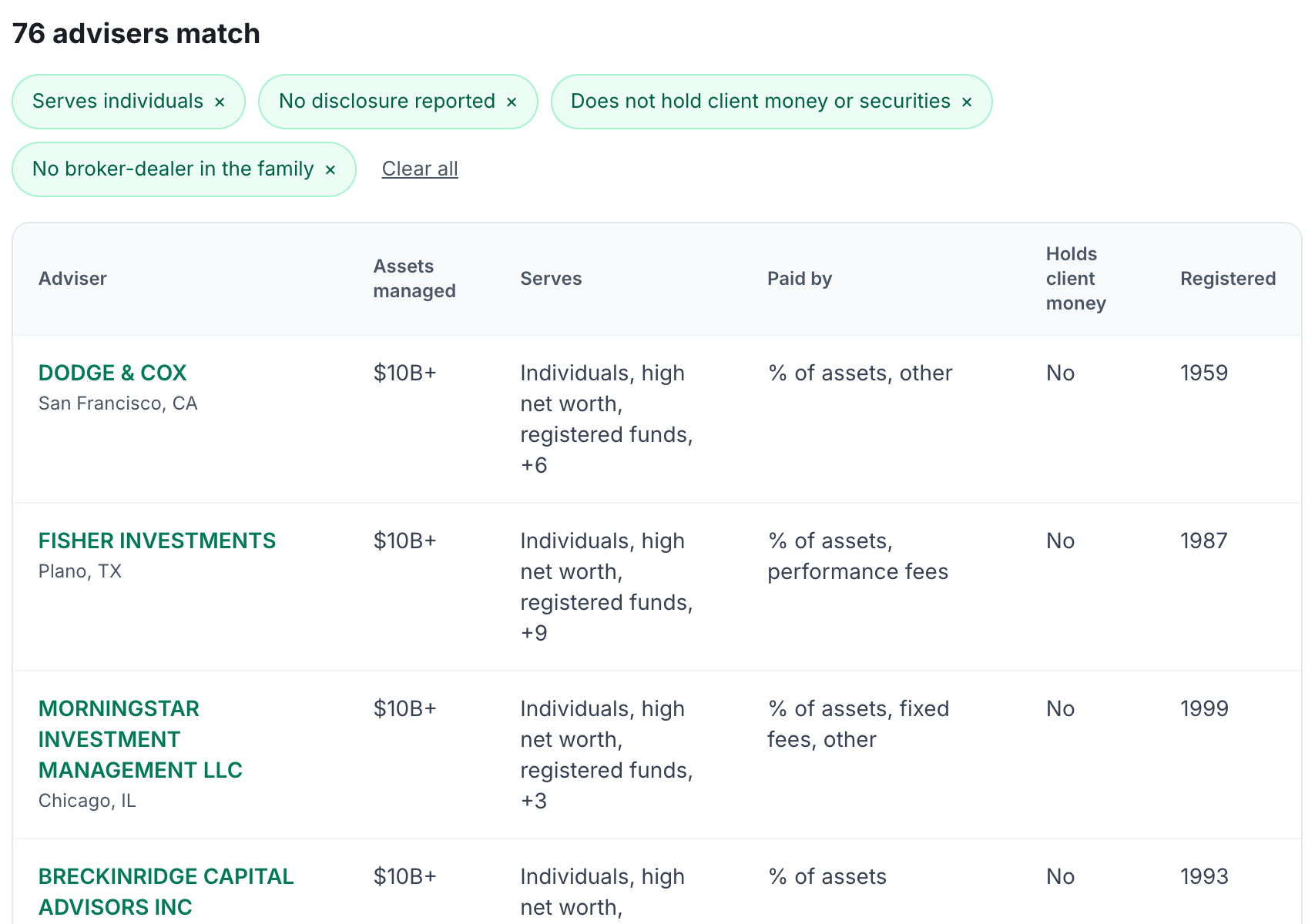
The adviser screener on Moneyta takes those answers for more than fourteen thousand SEC-registered advisers and makes them filters. Nothing is scored, ranked or rated by us. Every answer is the firm's own, from its latest filing, checked against the SEC's register every day. Tick what matters to you and the list narrows to the firms that report all of it.
- Who it serves: individuals, high net worth individuals, pension plans, charities, private funds.
- How it is paid: a percentage of assets, hourly, fixed fees, fixed fees only, commissions, performance fees.
- What it does: financial planning, managing portfolios for individuals, pension consulting, picking other advisers for you, advising private funds, or serving clients through a website only.
- On the record: no disclosure reported, does not hold client money or securities, no broker-dealer in the family, does not sell insurance.
- Where: the state of the main office, the states the firm may do business in, and a free-text search by name or city.
It is open to everyone, with no sign-up. A free account adds the figures: each firm's reported assets, clients and accounts, the share it manages with discretion, and filters and sort orders on those numbers. Any screen is a link, so you can send a shortlist to a spouse or a friend exactly as you built it.
Look up any registered adviser's record, free.
Start freeA five-minute due-diligence pass
Here is how we would use it in the week before signing anything. Not as a verdict, but as a set of questions you can now answer in one place.
- Does the firm serve people like me? Tick Individuals. A firm whose clients are pension plans and private funds is not a bad firm, it is just built for someone else.
- How does it get paid? Tick the ways you are comfortable with, then look at whether the firm reports others as well. A firm paid by commissions or performance fees on top of a percentage of assets is not disqualified; you simply want to hear about it from the adviser, not discover it later. One box deserves a word of its own: the SEC's question is check all that apply, and nearly every firm that ticks Fixed fees also ticks a percentage of assets. Fixed fees only narrows to the firms that report fixed fees and no other way of being paid. It is a short list, under two hundred firms in the whole register, and it is the one to use if a flat fee is what you are after.
- Does it hold my money? Tick Does not hold client money or securities. Most advisers use a separate custodian, which means the firm can direct your account but cannot walk off with it. A firm that reports custody has extra rules to follow, and it is worth a direct question.
- What else is under the roof? No broker-dealer in the family and Does not sell insurance remove the firms that also earn from selling you products. Again, not a verdict. A question to ask.
- Is anything on the record? No disclosure reported keeps the firms that answered no to all of the SEC's event questions. A firm with events reported deserves a read of the actual record rather than an assumption: some events are decades old or minor, some are not, and the SEC's site shows each one.
- How long has it been here? Sort by Longest registered, or with a free account set Registered by a year.
Run that screen and the list usually drops from thousands to a few hundred. Add a state and it drops to a page or two. That is a shortlist built from the firms' own words, in less time than the first meeting takes.
Then read the firm's page
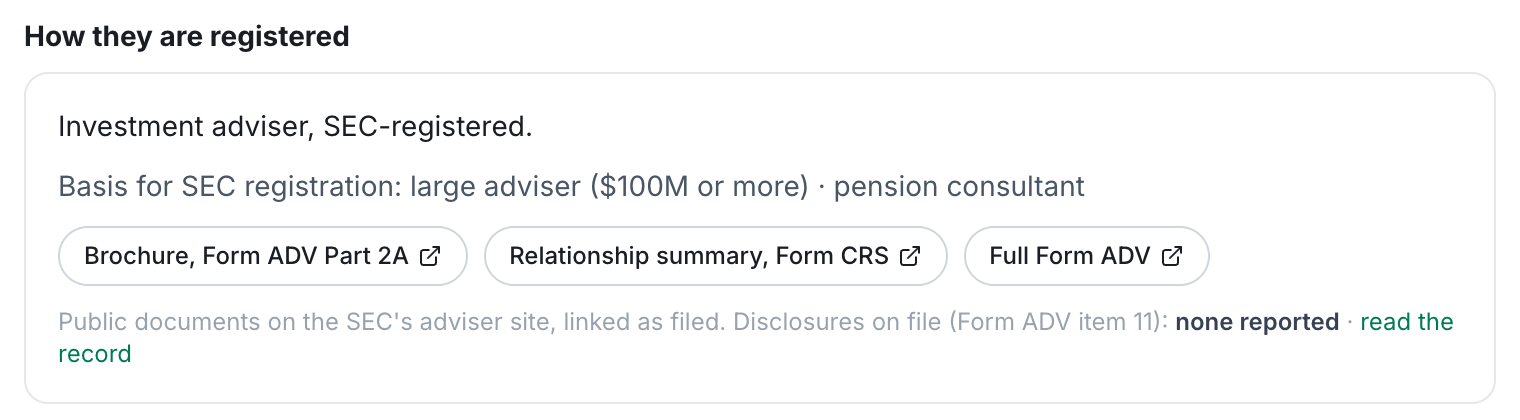
Every adviser in the screener has a page. It shows the firm's registration status and whether it is registered as an internet adviser (a firm that serves clients through a website rather than in person). With a free account you see the basis the firm claims for its registration, the public documents on the SEC's site linked as filed (the Part 2A brochure, the relationship summary, and the full Form ADV), whether disclosures are on file, and the reported figures. With a subscription you see the people: the executive officers and owners from the firm's filing, with their titles and ownership bands, and the funds the firm advises. And when the firm is also one that discloses its holdings to the SEC each quarter, its page shows that book in brief, so you can see what the firm actually owns on behalf of clients, not just what it says about itself.
Fund managers too
The same release adds a second screener, for the managers that disclose their holdings to the SEC every quarter: by the size of the book, how many positions it holds, whether it grew or shrank on the quarter, and where the manager's main office is. If your adviser is one of them, or you simply want to know what the large managers in your state own, it is the same idea. Public filings, filters, a shortlist.
And after you sign: keep verifying
Due diligence does not end at the signature. The adviser you choose will make decisions in your account every quarter, and the whole point of the books we built is that you can watch them. Connect the account and the books reconcile themselves. Put the firm's disclosed book beside your own as a shadow book and see what changed each quarter. Set alerts for the drift and the concentration you did not ask for. Trust is a decision you make once. Verification is a habit, and we wanted it to be a cheap one.
RelatedThe books professionals keep, for your own moneyStart with the questionnaire
If you are choosing an adviser this year, or wondering about the one you have, open the screener and tick the four or five things you would want to be true. The shortlist is free, the firm pages are free, and a free account shows the figures. Then go have the coffee. Your gut will do the rest, with the facts already in your pocket.
Screen advisers by what they report to the SEC, free and with no sign-up.
Start freeEvery new account starts with 14 days of Gold: every feature on, no card. Then Free, unless you choose a plan.
Frequently asked questions
How do I check whether a financial adviser is registered with the SEC?
Search the firm's name on the SEC's Investment Adviser Public Disclosure site, or on Moneyta's adviser screener, which lists SEC-registered investment advisers from the SEC's register and shows each firm's registration status, the basis it claims for registration, and links to its filed documents. Advisers registered only with a state, and brokers, are listed elsewhere: state regulators and FINRA's BrokerCheck.
My adviser is an individual, not a firm. Can I still check them?
Yes. An individual adviser is either a representative of a registered firm or a one-person practice that is itself the registered firm; both kinds of firm file Form ADV, so the firm behind the person is on Moneyta's adviser screener and has a page there. The individual's own record, with their registrations, employment history and any disclosures, is on the SEC's adviser site and on FINRA's BrokerCheck, and is worth reading alongside the firm's filing.
What is Form ADV?
Form ADV is the registration form an investment adviser files with the SEC and updates at least once a year. Part 1 is a questionnaire about the firm: its clients, fees, services, assets under management, custody of client assets, other businesses and any disciplinary or regulatory events. Part 2 is a plain-English brochure, and Form CRS is a short relationship summary for retail clients. All of it is public.
What does it mean when an adviser holds client money or securities?
It means the firm reports custody of client assets on its Form ADV: it can hold or access the money or securities itself rather than only directing an account held at a separate custodian such as a brokerage or bank. Custody is legal and common for some business models, and it comes with extra rules such as surprise examinations, but it is worth a direct question before you sign.
What is a disclosure on Form ADV?
Item 11 of Form ADV Part 1 asks the firm a series of yes-or-no questions about criminal, regulatory and civil judicial events involving the firm or its people. Answering yes to any of them is a disclosure, and the details are on the SEC's adviser site. A disclosure is a reason to read the record, not a verdict: events range from minor and decades old to serious and recent.
Is the Moneyta adviser screener free?
Yes. The list, the filters on who a firm serves, how it is paid, what it does, what is on its record and where it is, and every adviser's page are open to everyone with no sign-up. A free account adds the reported figures: assets, clients, accounts and the share managed with discretion. A paid plan adds the names and titles of a firm's executive officers and owners from its filing.
Does Moneyta recommend financial advisers?
No. Moneyta is not an investment adviser and does not recommend, rate or rank advisers. The screener shows what each firm reported to the SEC on its own Form ADV, as filed, so you can build a shortlist from the firms' own answers and verify them with the firm and the SEC before you decide.
What is an internet investment adviser?
An internet adviser is a firm registered with the SEC under an exemption for advisers that serve their clients through an interactive website rather than in person. Moneyta marks these firms on the screener and on their pages, and shows the website named on the filing when the firm reports one.
Can I see who owns or runs an adviser firm?
Yes. Schedule A of Form ADV lists a firm's executive officers and direct owners with their titles and ownership ranges. On Moneyta the count is shown on every adviser's page, and the names and titles come with a paid plan. The full schedule is also in the firm's Form ADV on the SEC's adviser site.