
Situational Awareness After the Blowup: The Adviser, the Fund and the Holdings, Filing by Filing
Situational Awareness LP's third-quarter holdings report is in: $1.6 billion, down from $20.2 billion, and two thirds of it call options. We read it beside the firm's own adviser filing and its private fund's record on Moneyta, screen by screen, and show what each filing can and cannot tell you.
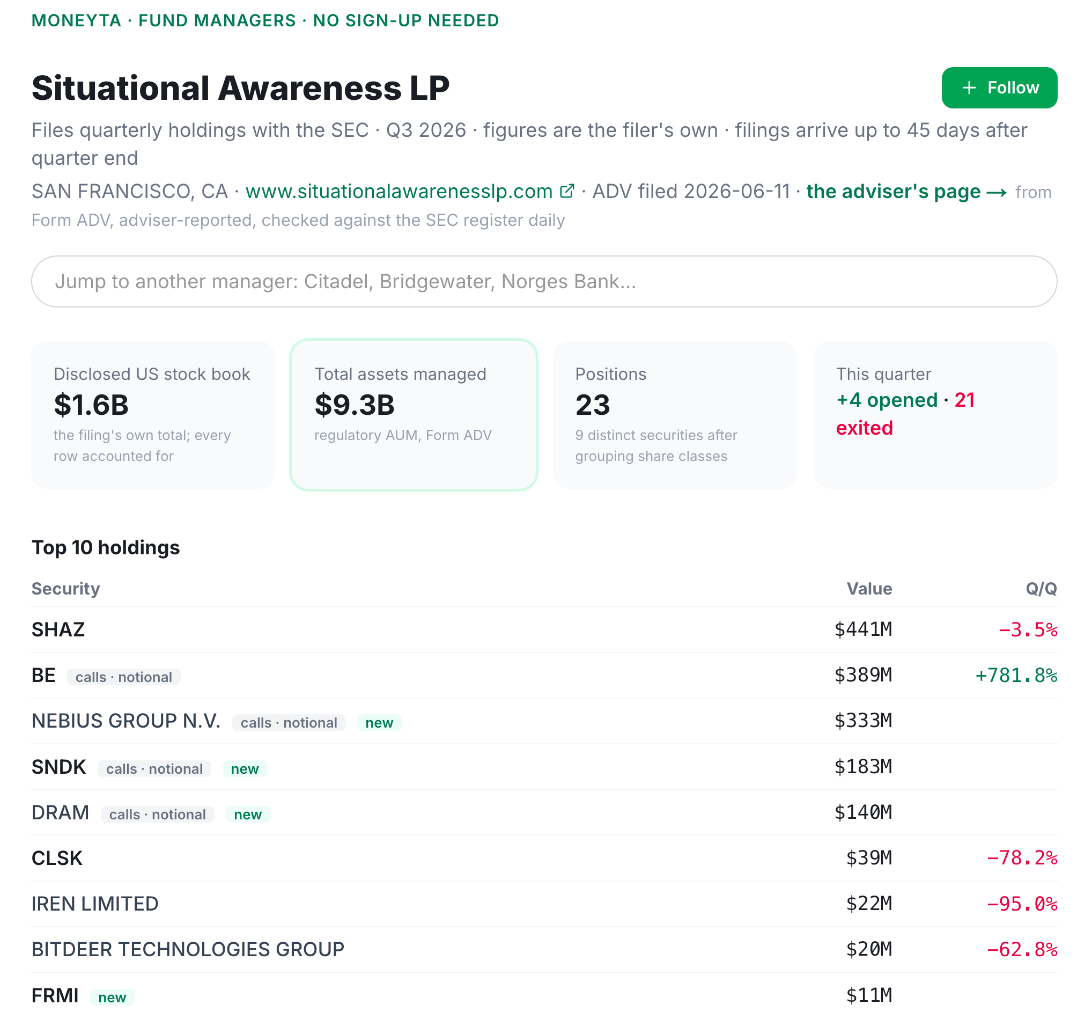
On November 16, the filing deadline, Situational Awareness LP filed its holdings report for the quarter that ended September 30. It is the first report from the fund that covers the weeks after its reported forced selling in late July, and the number at the top says most of it: a disclosed US stock book of $1.6 billion, down from $20.2 billion one quarter earlier.
In August we wrote about what the fund's first four holdings reports showed and what they could not. This post picks up where that one stopped. A firm like this leaves three separate records with the SEC: the quarterly holdings report, the adviser's own registration filing, and the details of the private fund it runs. Moneyta puts each one on its own page. Here they are side by side, with what each one adds and where each one goes quiet.
1. The holdings: a $1.6 billion book, two thirds of it options
The fund manager page above shows the report as filed on November 16, free to read with no account. It lists 23 rows across 9 securities, $1,577 million in all. Set it beside the second-quarter report and the change is plain:
- Size: $20.2 billion across 24 securities on June 30; $1.6 billion across 9 securities on September 30.
- Turnover: counting each security and each option type as a position, 21 positions exited, 5 stayed and 4 were opened.
- The two largest names in June, SanDisk at $5.7 billion and Micron at $5.6 billion, are gone as shares. Micron does not appear at all. SanDisk is back only as call options, $183 million of them.
- Call options make up about $1,045 million, two thirds of the report: Bloom Energy ($389 million), Nebius ($333 million), SanDisk ($183 million) and the Roundhill Memory ETF, DRAM ($140 million).
- The largest share position is SharonAI (SHAZ): 8.07 million shares worth $441 million. The fund held 5.40 million shares in June, so it added about half again, even though the position is worth slightly less than it was then.
- The rest are small share positions in bitcoin miners and power names: CleanSpark ($39 million), IREN ($22 million), Bitdeer ($20 million) and Fermi ($11 million).
So the September book is small, and most of what is in it is a bet on direction carried through options rather than shares. That is the opposite of June, when the report was nearly all shares and the options had been stripped out. What the report cannot say is whether this is the fund's whole public exposure, how the calls were financed, or what the fund holds outside US listings. Those limits are the same as before, and they mattered more than anything the report showed.
One more thing the report settles, and one it cannot. Press reporting in July said the fund sold its entire public stock book. This report still lists about $530 million of shares on September 30, and more SharonAI shares than in June. So either the fund bought back in after the selling, or the selling did not reach every line. The filing shows where the book ended up, not the path it took to get there.
2. The adviser: a June snapshot of a $9.3 billion firm with eight people
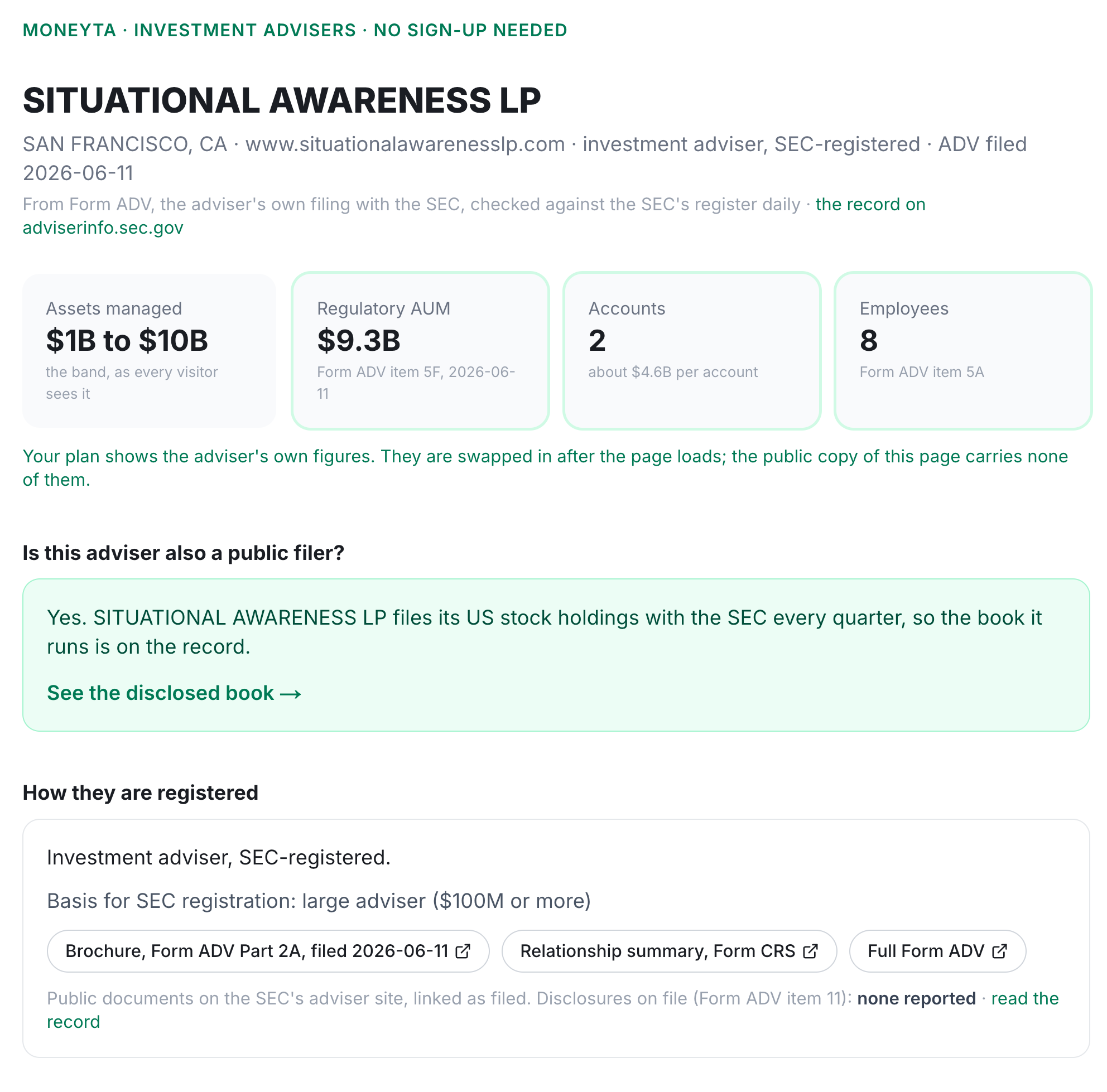
Every registered investment adviser files Form ADV and keeps it current. Situational Awareness filed its latest on June 11, 2026, at the height of the run. It reports $9.3 billion of regulatory assets in 2 accounts, run by 8 employees. It is registered as a large adviser, its brochure and relationship summary are linked as filed, and it reports no disciplinary disclosures.
Two things stand out. First, the two big numbers do not measure the same thing. Regulatory assets on Form ADV are counted gross, as of a date within 90 days before the adviser files, while the holdings report is a quarter-end snapshot of US-listed positions, with options at notional value. $9.3 billion here and $20.2 billion on the June 30 holdings report are both true; they just answer different questions, and neither one shows how the positions were financed. Second, the date. The adviser filing is from June, before the July selling. Form ADV is updated at least once a year and sooner for certain changes, so until the firm amends it, the adviser page still describes the firm at its peak. The page shows the filing date for exactly this reason.
The page also links straight back to the holdings: the adviser files quarterly holdings too, so its book is on the record. That two-way link is what lets you check a firm's own description of itself against what it actually reported owning.
3. The fund: 81 investors, a $5 million minimum, and five banks
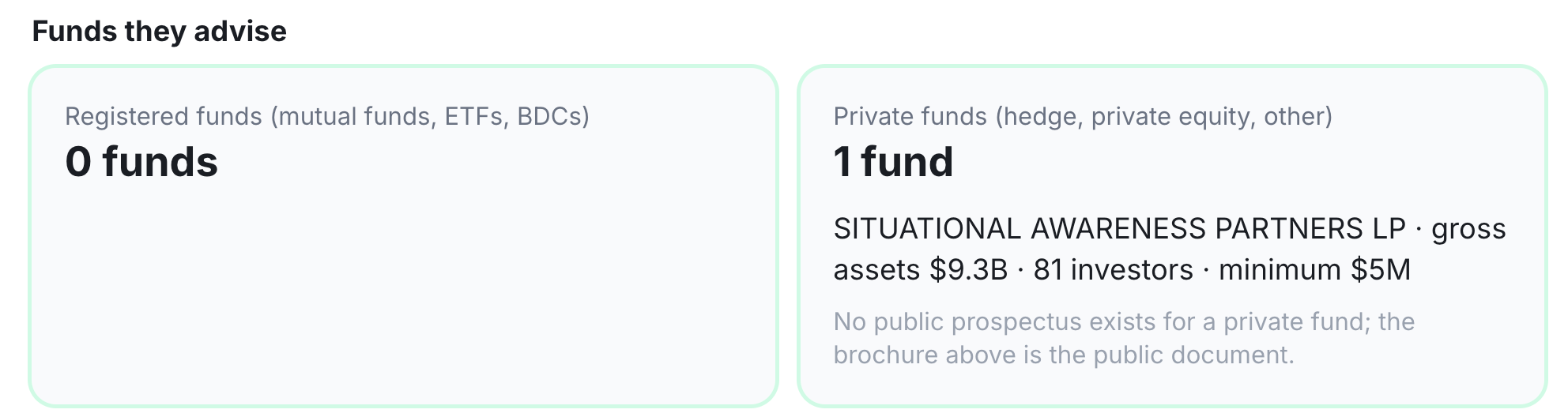
Part 1 of Form ADV lists every private fund an adviser runs. Situational Awareness reports one, Situational Awareness Partners LP, a master fund with an offshore feeder, with gross assets of $9.3 billion, 81 investors and a $5 million minimum investment. Private funds have no public prospectus; the adviser's brochure is the public document.
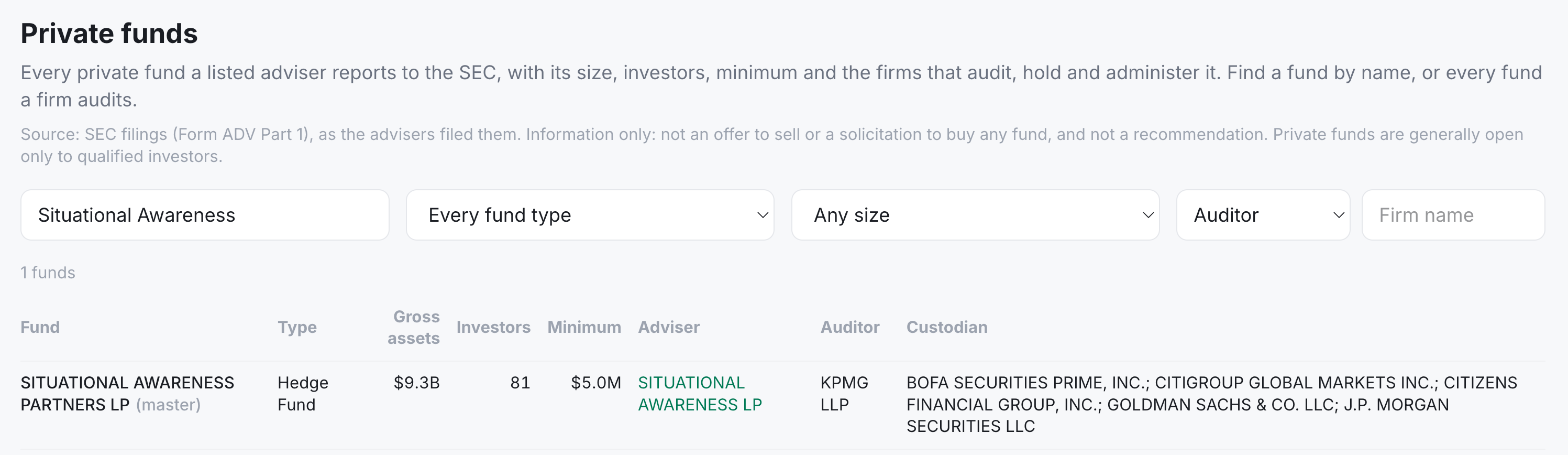
The private fund screen adds the firms around the fund: KPMG as auditor, and five custodians, BofA Securities Prime, Citigroup Global Markets, Citizens Financial Group, Goldman Sachs and J.P. Morgan Securities. The filing records four of the five, all but Citizens, as the fund's prime brokers: the desks that hold a fund's securities and lend against them.
This is the closest any public filing comes to the story's missing piece. In August we wrote that the margin terms, the agreements that actually force a sale, are in no public filing. That is still true. But the adviser filing does tell you who the fund's counterparties are, and how many investors stood behind it. It names the lenders' side of the table. It does not show the terms.
Learn by reviewing what the professionals actually do. Open any fund manager's holdings, its adviser record and its funds side by side, and follow the ones you want to learn from. Free to start, no card.
Start freeWhat the three filings say together
- The holdings report is the most current and the narrowest: long US positions and options at notional value, 45 days after the quarter, with no leverage, shorts or foreign listings.
- The adviser filing is the broadest and the slowest: who the firm is, its size, accounts, people and record, as of the date it was last filed.
- The private fund record fills in the structure: how big the fund is, how many investors it has, the minimum, and the auditor and banks around it.
- Read alone, each one can mislead: a $20 billion book, a $9 billion firm, a fund with 81 investors. Read together, they show a concentrated book, run by a small team for a small number of investors, held at banks that lend against what they hold.
None of this would have predicted the timing of July. It would have told a careful reader that the book was concentrated in a few names, held through prime brokers, and changing fast from quarter to quarter. That is a description of risk, not a forecast, and it is about as much as public filings can give.
Situational Awareness is one firm. The same three records exist for thousands of professionals, and reading them quarter after quarter is one of the best ways we know to learn how professionals build, size and change a book: what they buy, what they let go, and how fast. You do not have to copy anyone to learn from them.
Every figure here is from the firm's own SEC filings as they stand on November 17, 2026, which we store and can recompute; press figures in our earlier post are attributed to the outlets that reported them. Moneyta is not affiliated with the firm. Historical facts, not predictions. Insight, not advice.
Learn from the professionals, filing by filing: follow the managers you want to study and hear when each new holdings report lands. Free to start, no card.
Start freeEvery new account starts with 14 days of Gold: every feature on, no card. Then Free, unless you choose a plan.
Frequently asked questions
What did Situational Awareness LP report for the third quarter of 2026?
Its holdings report for the quarter ended September 30, 2026, filed November 16, lists 23 rows across 9 securities worth $1.58 billion, down from $20.2 billion on June 30. About two thirds of the total is call options at notional value, on Bloom Energy, Nebius, SanDisk and the Roundhill Memory ETF; the largest share position is SharonAI at $441 million. Micron is gone and SanDisk remains only as calls.
How big is Situational Awareness as an adviser?
Its Form ADV, filed June 11, 2026, reports $9.3 billion of regulatory assets in 2 accounts, 8 employees, and one private fund, Situational Awareness Partners LP, with gross assets of $9.3 billion, 81 investors and a $5 million minimum, audited by KPMG. Those figures are as of that filing, before the reported selling in July.
Can SEC filings show a fund's leverage?
No. The quarterly holdings report lists long US positions and options at notional value, with no borrowing, shorts or foreign listings. The adviser's Form ADV names the fund's custodians and prime brokers, and its size and number of investors, but not the financing terms. The agreements that decide when a lender can force a sale are in no public filing.