
$10,000 in Nvidia at the Peak Is Now $6,947. How to Be Ready for the Next Drop
Nvidia fell 30.5 percent from its October 6, 2026 close. At 28.8 percent of a portfolio, that one drop took 8.8 percent off everything; at 5 percent, 1.5. Here is the arithmetic, what Goodwin says about a portfolio like that, and how to see where yours stands in a minute.
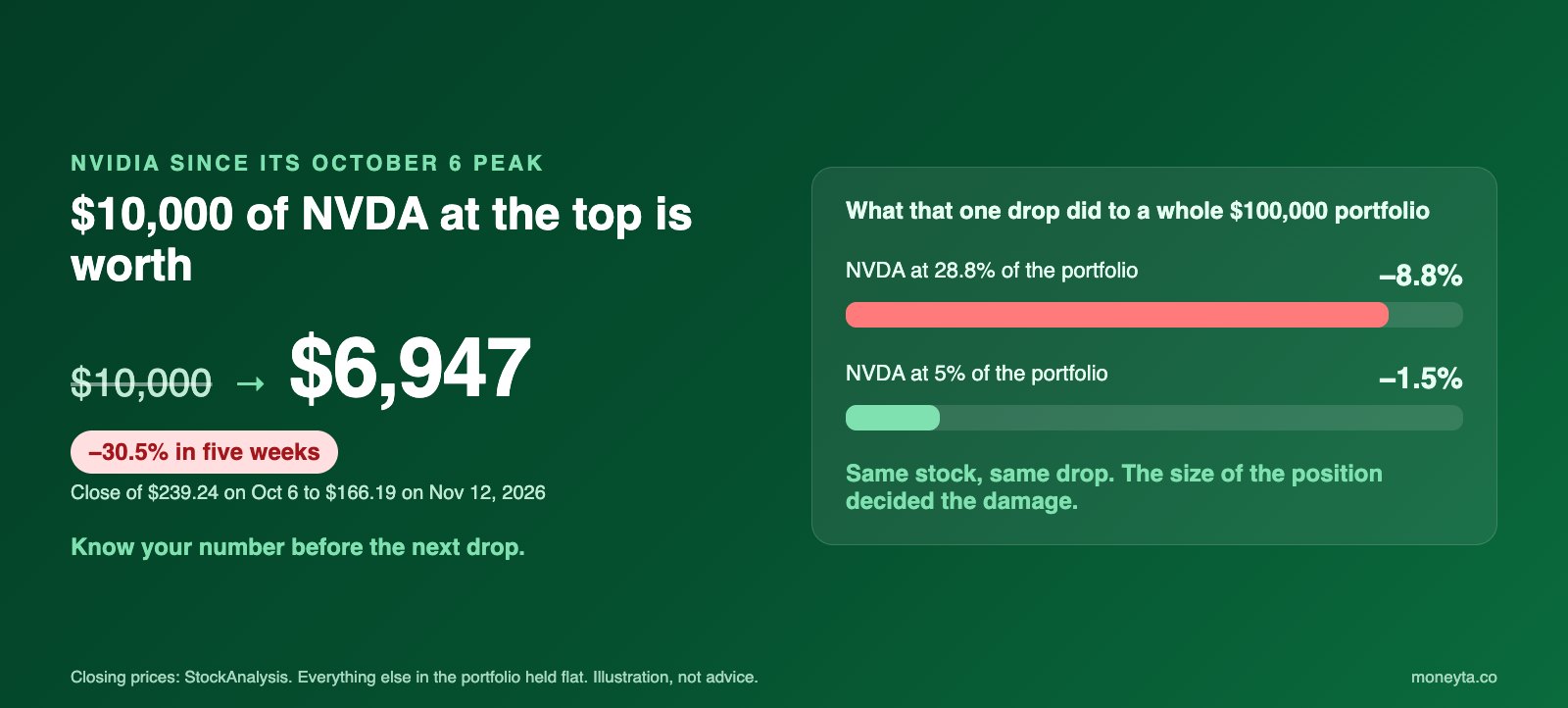
If you had $10,000 in Nvidia at the peak, here is what you have now
Nvidia's highest close in at least five years came on October 6, at 239.24 dollars a share, by Nasdaq.com's price history. Then the AI and chip trade cracked. Late October took the first bite, the narrow rout we wrote about earlier this month, and November took more: minus 9.26 percent on November 5, minus 4.27 percent on November 9 and minus 5.47 percent on November 10. On November 12 the stock opened near 151 dollars and touched 148.80, a new 52-week low, before recovering to close at 166.19, still down 4.34 percent on the day. All of those figures are from StockAnalysis's daily price history.
On a 10,000 dollar position bought at that October 6 close, that is about 3,053 dollars gone, leaving roughly 6,947. Nvidia reports its quarterly results after the market closes on November 17, according to the company's own announcement, so the stock may move a long way in either direction from here. Nobody knows which way, and this post is not going to guess. It is about the question that has an answer now: what did that drop do to your whole portfolio?
What one stock did to your whole portfolio
A stock's fall only hurts your portfolio in proportion to how much of the portfolio it is. The arithmetic is short: the stock's drop times its weight. Take a 100,000 dollar portfolio, let Nvidia fall 30.5 percent from its October 6 close, and hold everything else flat:
- Nvidia at 28.8 percent of the portfolio (28,800 dollars): the portfolio falls 8.8 percent, about 8,794 dollars, from one stock.
- Nvidia at 15 percent (15,000 dollars): the portfolio falls 4.6 percent, about 4,580 dollars.
- Nvidia at 5 percent (5,000 dollars): the portfolio falls 1.5 percent, about 1,527 dollars.
Nobody plans to have 28.8 percent of their money in one chip maker. It usually happens the pleasant way: you buy a reasonable amount, the stock triples, and one day the winner is nearly a third of what you own. That is why concentration so often goes unnoticed. Every step of it felt like good news. The 28.8 percent above is not picked at random, either. It is what Nvidia weighed in our demo portfolio in September, two months before the drop.
What is your number? Paste in what you hold and see your largest position and your sector weights in about a minute. Free to start, no card.
Start freeWhere the demo portfolio stands now
Here is that demo portfolio on Moneyta, analyzed on November 12 and priced at the latest closes the dashboard had stored, November 11. These are real screens from moneyta.co, on a demo portfolio we built in our own account with ten made-up holdings, not anyone's real money. About 316,000 dollars, a Moneyta Score of 74 out of 100, a B, and up 75 percent on what it cost at those prices.
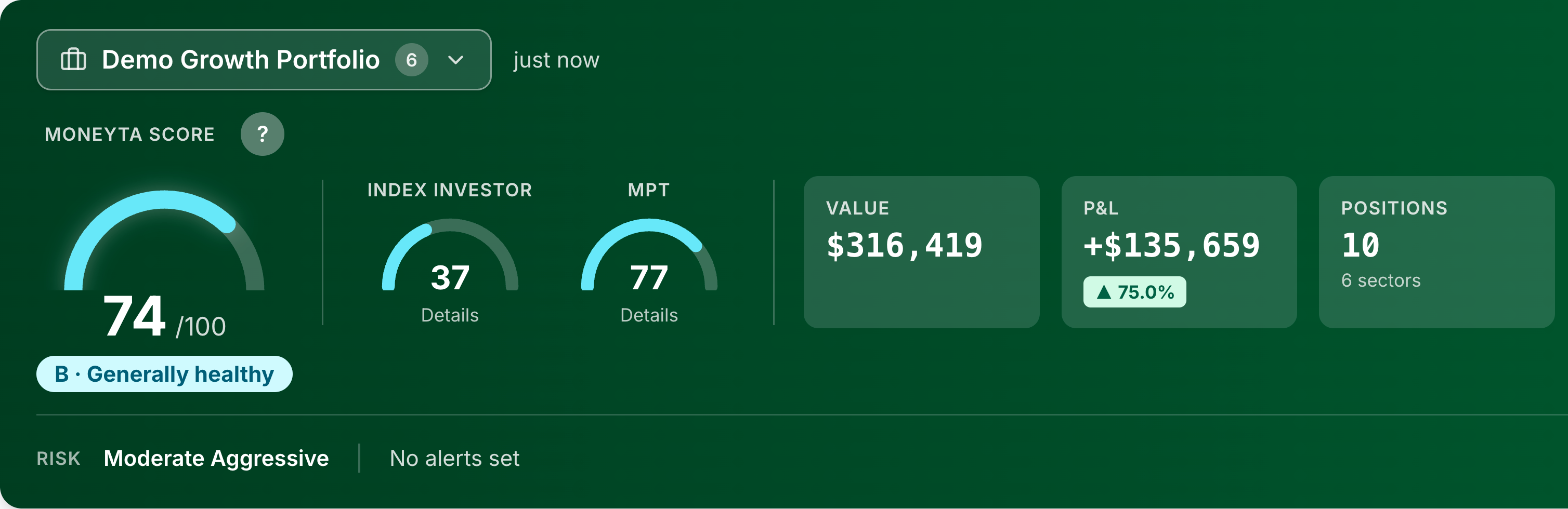
Look at what the drop did to the concentration. In September, Nvidia was 28.8 percent of this portfolio. At the November 11 close it was about 23 percent. Nobody sold a share. The stock fell, so its slice shrank. That is concentration correcting itself the painful way.
And here is something worth knowing about how Goodwin, the narrator on your dashboard, reads it. Goodwin measures a portfolio against its owner's risk profile, and this demo sits in an account set to moderate-aggressive, where Moneyta draws the single-position line at 30 percent. At that profile a largest holding of 23 percent is not a warning, and Goodwin counts it as a strength. At a moderate profile, where the line is 20 percent, the same 23 percent would be flagged as worth reviewing. What Goodwin does flag here, first and alone, is the sector: technology is 47.6 percent of the portfolio, and Nvidia is the biggest piece of it.
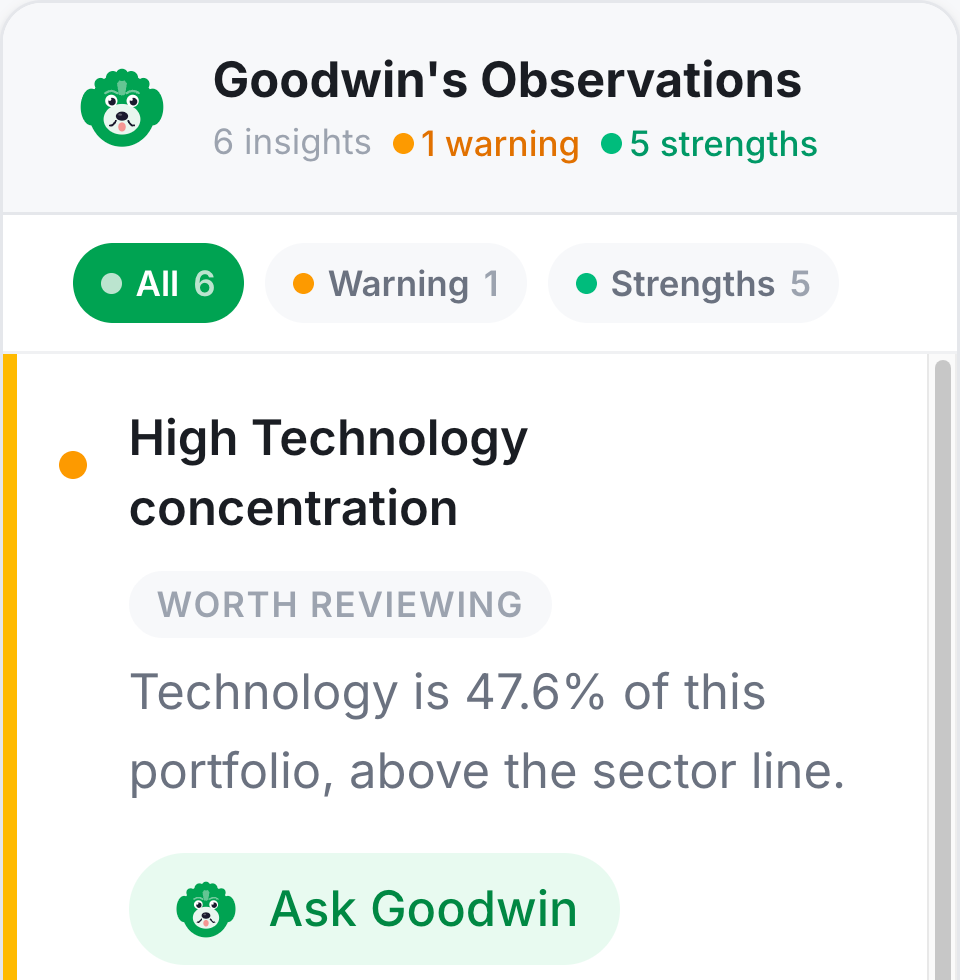
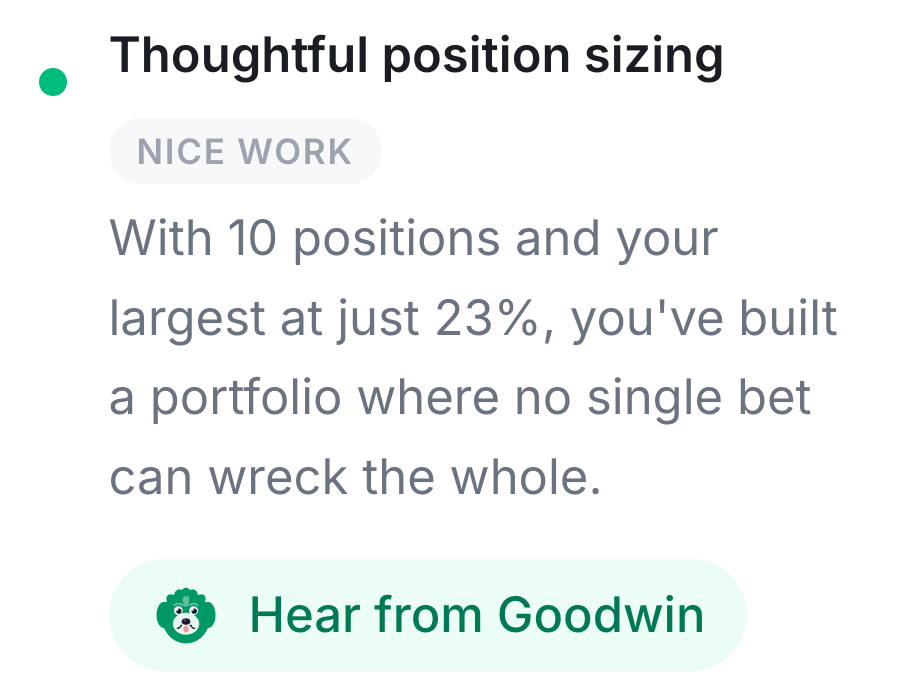
Both observations are true at once, and the arithmetic shows why. At 23 percent, a 30 percent fall in Nvidia costs this portfolio about 7 percent: real money, though not a wreck. The sector is where the bigger exposure sits, because Nvidia, Microsoft, Apple and Alphabet often move together when the AI trade turns. Whether 23 percent is too much for you depends on your own profile, which is exactly why Moneyta asks for it.
Ask Goodwin where your portfolio stands
Every observation has a Goodwin button: Ask Goodwin on a warning, Hear from Goodwin on a strength. Press it and Goodwin explains the observation in plain English against your own holdings: what the number is and why it matters. Here is what it said about the demo's technology weight on November 12, unedited:
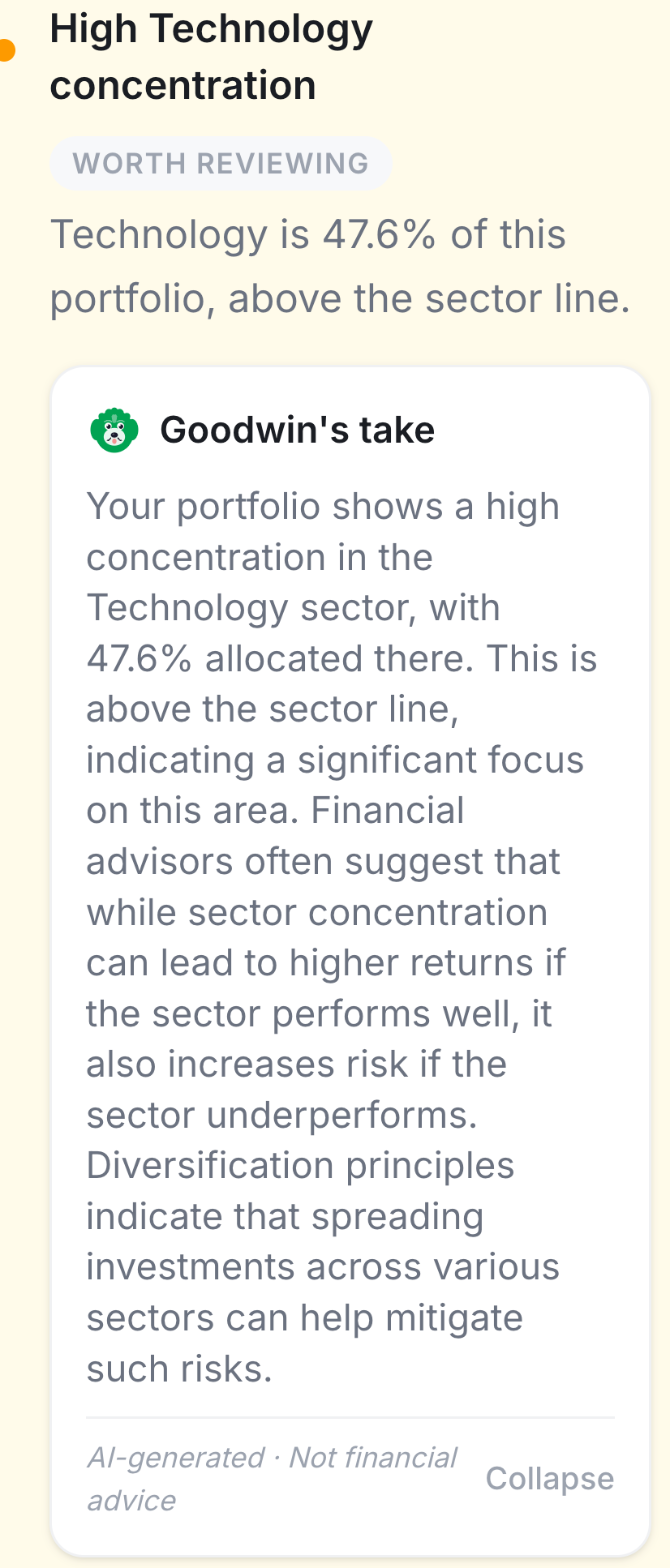
Notice what it does not say. It does not say sell Nvidia, and it does not say hold it. Moneyta is not an advisor. Goodwin describes your portfolio and explains what the description means, and the decision stays yours, or your advisor's. What changes is that you make it with the number in front of you, instead of finding it on a brokerage statement after the fact.
Read Nvidia's research before the headline does
Knowing your weight is half of it. The other half is knowing the stock. Nvidia is one of Moneyta's featured research names, open to everyone, and we ran its research desk again on November 12 so this post shows a fresh read. The desk's analysts read the filings, argue both sides, keep the claims that survive the debate and mark the ones it weakened, each with its source. The snapshot: the desk's read is cautious, 12 claims upheld, 2 weakened and none dropped, on evidence as of November 12.
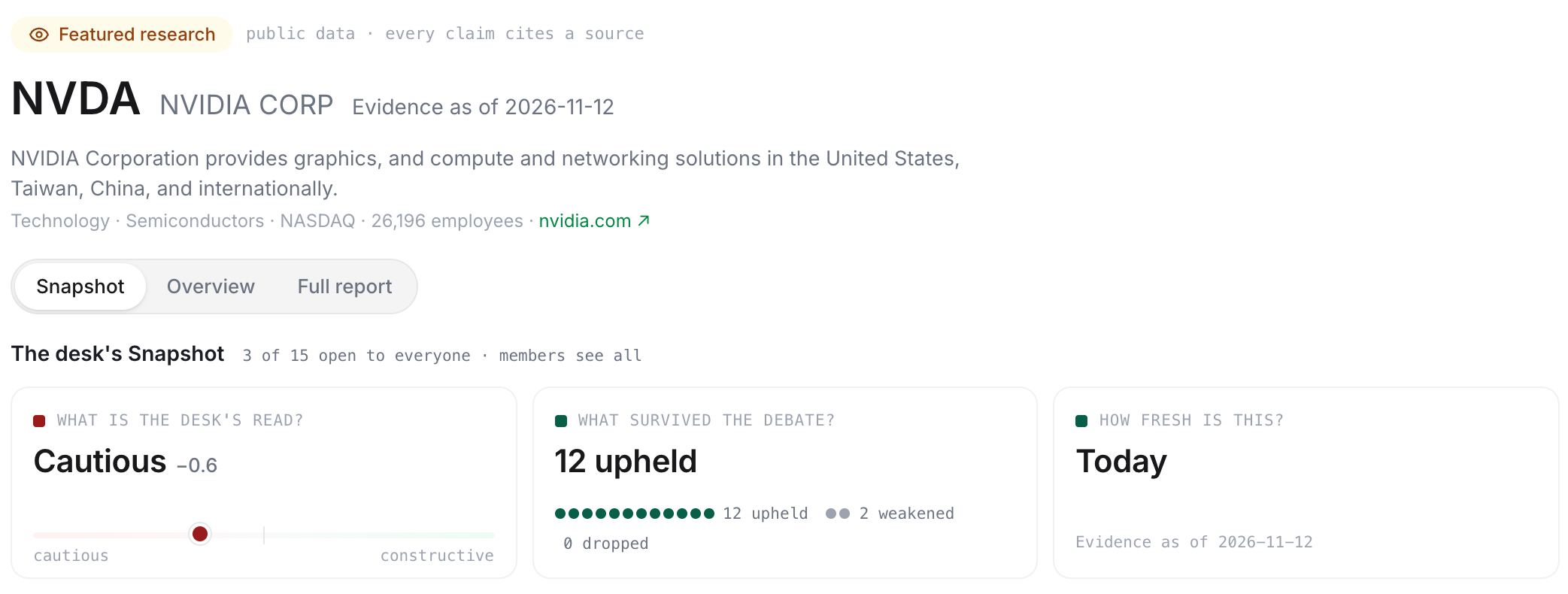
A cautious read is not a forecast and it is not a verdict on the company. It is the desk saying the evidence it could check leans that way, and showing its work. Read the open cards, then the overview, and decide what you think. On Silver and Gold, members see the full report on every name they hold, which is the version that matters most: research on the stocks already in your portfolio, next to how much of the portfolio each one is.
The good news: concentration is how winners happen
Here is the part that gets lost in a week like this. Even at the November 12 close, the demo's Nvidia shares are still up about 66 percent on what they cost. Concentration is usually the reason a portfolio did well in the first place. Professionals do not avoid big winners. They decide, on purpose, how big a winner is allowed to get, and they write that number down before the stock decides it for them.
You can see the same numbers they see, and none of it requires a prediction:
- Know your number. Paste in what you own and read your largest position and your sector weights. If one name is near a quarter of the portfolio, a 30 percent drop in it takes 7 to 8 percent off everything.
- Look inside your funds. An S&P 500 or Nasdaq fund holds Nvidia too, so your real exposure is your own shares plus every fund's slice of it. On Silver and Gold, Moneyta's ETF look-through adds them up.
- Test a change before you make it. The What-If tool shows what a trade would do to your concentration, the position's new weight and your score before any money moves.
- Hear about it early. On Silver and Gold you can set an alert on a position's weight, and on Gold on a sector's, so the next time one quietly grows past your line you hear about it in a calm week instead of a loud one.
- If you rebalance, the rebalancing guide covers how people pick a band and stick to it.
See where your portfolio stands before November 17
Whatever Nvidia's results bring on November 17, the useful question is the same one: how much of what you own rides on it? Paste in your holdings, read your score and Goodwin's top observations, and press the Goodwin button on anything you want explained. It takes about a minute, it is free to start, and there is no card. Then the next big move in one stock is a number you already knew, not a surprise on a statement.
Know your number before Nvidia reports on November 17.
Start freeEvery new account starts with 14 days of Gold: every feature on, no card. Then Free, unless you choose a plan.
Frequently asked questions
How much is $10,000 of Nvidia bought at the October 2026 peak worth now?
About 6,947 dollars. Nvidia closed at 239.24 dollars on October 6, 2026 and at 166.19 dollars on November 12, 2026, according to StockAnalysis's daily price history, a fall of 30.5 percent. A 10,000 dollar position bought at the October 6 close lost about 3,053 dollars.
How much does a 30 percent drop in one stock hurt my whole portfolio?
Multiply the drop by the stock's weight in your portfolio. A 30.5 percent fall in a stock that is 28.8 percent of the portfolio takes about 8.8 percent off the whole portfolio, if everything else holds flat. At a 15 percent weight it takes about 4.6 percent, and at 5 percent about 1.5 percent.
How much of my portfolio should be in one stock?
There is no single right number, and Moneyta does not tell you what to hold. Many professionals set a limit for any one position and write it down in advance. Moneyta shows your largest position and sector weights, flags a position that crosses the line for your risk profile (20 percent at a moderate profile, 30 percent at moderate-aggressive), and lets you test a change before you make it.
What is Ask Goodwin?
Goodwin is the narrator on the Moneyta dashboard. Every analysis turns your holdings into ranked observations, such as a single position or a sector that is a large share of the portfolio. The Goodwin button on each one explains it in plain English against your own holdings. It describes and explains; it does not recommend buying or selling.
Is Moneyta's Nvidia research free to read?
Yes. Nvidia is one of Moneyta's featured research names, and its page at moneyta.co/research/featured/NVDA is open to everyone with no account. It shows the research desk's read, what survived the desk's debate and how fresh the evidence is. Silver and Gold members see the full report, and the same research for every stock they hold.
Does owning an S&P 500 or Nasdaq fund add to my Nvidia exposure?
Yes. Large index funds hold Nvidia among their biggest positions, so your real exposure is your own Nvidia shares plus each fund's slice of Nvidia. On Silver and Gold, Moneyta's ETF look-through adds the direct holding and every fund's slice together into one effective weight.