
Anthropic IPO Day: What ANT Would Do to Your Portfolio, and How to Check Before You Decide
Anthropic priced its IPO at 83 dollars a share, above its range, and is expected to start trading on Nasdaq as ANT on November 19, 2026. Here is what its filing says about the offering, the lock-up and who already owns it, the one number to check before you decide, and what you can do in Moneyta on IPO day.
Anthropic's IPO, straight from the filing
On November 17, Anthropic, PBC filed the third amendment to its registration statement with the SEC. It offered 825 million Class A shares, 801 million from the company and about 24 million from existing holders, at an estimated 70 to 78 dollars each, to be listed on the Nasdaq Global Select Market as ANT. Demand pushed both numbers up. On November 18 the company filed to register 155 million more shares, plus a larger underwriters' option, at an initial public offering price of 83 dollars a share, its filing says. That makes about 980 million shares, roughly 81 billion dollars before the underwriters' option, which now covers up to about 147 million more shares. The underwriters are represented by Goldman Sachs and Morgan Stanley, and the first trade is expected on November 19.
A prospectus runs to hundreds of pages. These are the parts that matter most to someone deciding whether, and how much, to buy:
- Retail access: the filing says shares will be offered to individual investors at the IPO price through Charles Schwab, Fidelity, Robinhood, SoFi, E*TRADE and Trade-PMR, and expects retail allocations to reach up to 20 percent of the offering, depending on demand.
- Who already owns it: after the offering, Amazon is expected to hold 14.7 percent of Anthropic's outstanding stock and Google 13.7 percent. Google, Nvidia, AMD, Broadcom, Micron, Microsoft and TSMC have also agreed to buy 26 billion dollars of non-voting shares at the IPO price, right after it closes.
- Who controls it: each Class A share has one vote, but a single Class F share, held by a company the seven co-founders own, carries 50.1 percent of the voting power, and the Long-Term Benefit Trust elects a majority of the board. Anthropic is a public benefit corporation and a controlled company under Nasdaq's rules.
- The business: revenue was 33.2 billion dollars in the first nine months of 2026, against 2.5 billion a year earlier, and 17.0 billion in the third quarter alone. The company puts its run-rate revenue at about 81 billion dollars as of October 31.
- The losses: the net loss for those nine months was 104.0 billion dollars, but 94.3 billion of it is an accounting charge for remeasuring convertible notes and similar instruments as the company's value rose. The operating loss was 1.3 billion.
- The lock-up: holders of about 15.5 billion shares agreed to limits on selling. For most of them the limits end after Anthropic reports its first-quarter 2027 results or 180 days after the prospectus date, whichever comes first; for the co-founders and some large holders, after the third-quarter 2027 results or 365 days. Up to 315 million shares can be sold from the first trading day, and up to 3.4 billion more may be released before the main date.
The number to know before you decide: how big would it be?
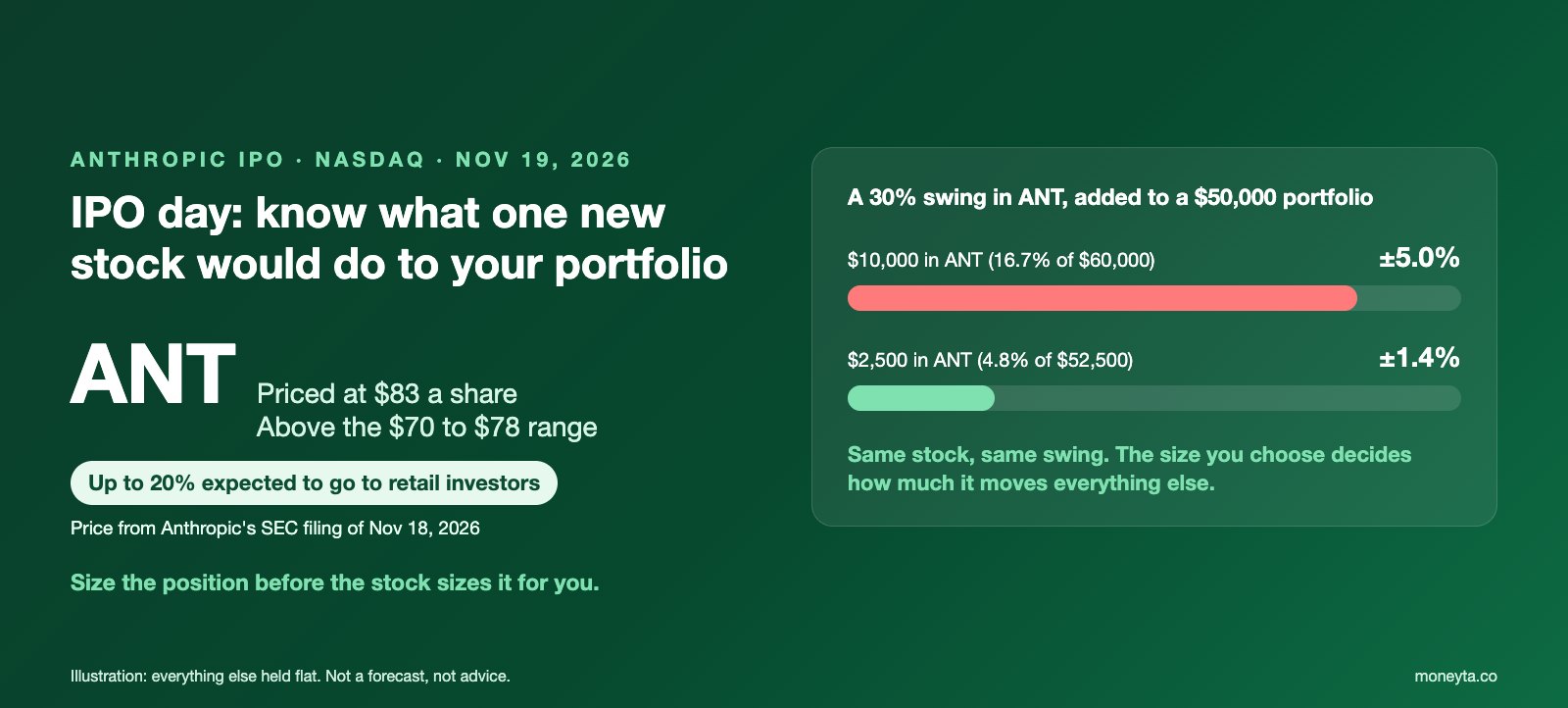
Nobody can tell you where ANT trades next week. What you can work out today is how much any move in it would move everything you own. The arithmetic is the same as for any single stock: the stock's move times its weight in your portfolio. Take a 50,000 dollar portfolio, add new money in ANT, let ANT move 30 percent either way, and hold everything else flat:
- 2,500 dollars in ANT: 4.8 percent of a 52,500 dollar portfolio. A 30 percent move changes the whole portfolio by 1.4 percent, about 750 dollars.
- 10,000 dollars in ANT: 16.7 percent of 60,000. The same move changes the whole portfolio by 5.0 percent, about 3,000 dollars.
- 25,000 dollars in ANT: a third of 75,000. The same move changes the whole portfolio by 10 percent, about 7,500 dollars.
A 30 percent swing is not a forecast; it is a round number for the kind of move a newly listed stock can make in its first weeks, up or down. The point is the size. The same stock and the same move can be a footnote or a tenth of your portfolio, and the only part you choose is how much you put in.
You may already own a piece of Anthropic
Before you add AI exposure, it helps to know how much you already have. Amazon and Alphabet together will hold more than a quarter of Anthropic's stock, by the filing's own count, and Nvidia and Microsoft are buying in alongside the IPO. All four are among the largest holdings of a standard, size-weighted S&P 500 or Nasdaq-100 fund. So if you own Nvidia shares and an index fund, your AI bet is already your Nvidia, plus each fund's slice of Nvidia, Microsoft, Alphabet and Amazon, before a single share of ANT.
Moneyta's ETF look-through (Silver and Gold) adds those up: your direct shares plus every fund's slice of the same company, as one effective weight. It shows your real weight in Amazon and Alphabet; it does not try to split those companies into the Anthropic stakes inside them. It is still the honest starting point, because it is often bigger than people expect.
RelatedYou own more of your favorite stock than you think: how fund look-through worksKnow your number before the first trade. Paste in what you hold and see your largest position, your sector weights and your Moneyta Score in about a minute. Free to start, no card, and every new account begins with 14 days of Gold.
Start freeFive things to do in Moneyta on IPO day
- Read where you stand now. Your dashboard shows your largest position, how much of the portfolio is technology, and Goodwin's top observations. If technology is already your biggest sector, ANT adds to it, not beside it.
- Write the call down before you make it. The Idea Pad (Free) keeps a dated note of why you are buying, what you would pay, and what would change your mind. It saves even before ANT has a closing price, and Moneyta measures the idea from the first close it has. When the main lock-up ends next spring, you will be glad you can read what you were thinking today.
- Test the size. The What-If tool (Silver and Gold) shows what a buy would do to the position's weight, your concentration and your score before any money moves. It needs a first price for ANT, so on the first morning it may ask you to try again later in the day.
- Add it after your order fills. Paste ANT with your share count and the price you actually paid, or let broker sync bring it in on a paid plan. Moneyta picks up prices for held stocks through the trading day, and the first official close lands that evening. Then run an analysis to see the new weights.
- Set your lines in advance. A price alert (every plan) tells you when ANT crosses a dollar level you choose, checked against the latest price Moneyta holds, which settles to each day's close. On Silver you can also set an alert on the position's weight, and on Gold on a sector's, so a winner that quietly grows past your limit gets noticed in a calm week.
What fills in over the following weeks
Some of what Moneyta shows for a stock needs history that a one-day-old listing does not have yet. We would rather say so than show a guess:
- Following ANT, and the nightly notes a follow brings, start once ANT is in the catalog of listed securities Moneyta tracks, usually within days of a listing.
- Insider trades: Anthropic's directors and officers report their trades to the SEC within two business days. With early sales allowed from day one and a lock-up ending in the spring, those filings are worth watching. On Gold they appear in the Insiders tab of the stock's research view once ANT is linked to its SEC record.
- Research and the public stock page: both work from filings and price history, and a stock with one day of trading has very little of either. Until there is enough evidence, the research desk says the stock is not covered yet rather than inventing a view, and the stock page waits for Anthropic's first reports as a public company. The prospectus itself is on the SEC's EDGAR site today.
- Professionals' positions: fund managers report what they held at December 31 within 45 days of the quarter's end, so the first look at which professionals bought ANT, and how much, comes by mid-February 2027.
- The lock-up: the main release comes no later than 180 days after the prospectus date, which falls in mid-May 2027, and sooner if Anthropic reports its first-quarter results before then. Put it in your Idea Pad note now. It is when far more shares can be sold, and it is one of the few dates about a stock that is set in advance.
And yes, you can ask Claude
If you use Claude or ChatGPT, Moneyta's connector lets either assistant read your own holdings when you ask: how big ANT is in your portfolio, what moves with it, what changed this week. It reads your figures and explains them; it cannot trade, and it does not tell you to buy or sell. Moneyta is not affiliated with Anthropic, and the connector is added as a custom connector, not one Anthropic lists or endorses.
Before the first trade
However ANT opens, the useful question is the same one we asked when Nvidia fell: how much of what you own rides on it? Paste in your holdings, read your largest position and your technology weight, and, if you do buy, decide your size before the ticker starts moving. It takes about a minute, it is free to start, and there is no card.
Size it before the stock sizes it for you.
Start freeEvery new account starts with 14 days of Gold: every feature on, no card. Then Free, unless you choose a plan.
Frequently asked questions
When does Anthropic stock start trading, and what is the ticker?
Anthropic's Class A shares are approved to list on the Nasdaq Global Select Market under the ticker ANT. The IPO was priced on November 18, 2026 at 83 dollars a share, and the first trade is expected on Thursday, November 19, 2026. A large new listing usually opens after the 9:30 a.m. Eastern bell, once Nasdaq's opening auction for it clears.
What was the Anthropic IPO price?
83 dollars a share, set on November 18, 2026, above the 70 to 78 dollar range in Anthropic's S-1/A of November 17. The company also enlarged the offering from 825 million to about 980 million Class A shares, roughly 81 billion dollars, with an underwriters' option for up to about 147 million more. The price is what investors who received an allocation pay; the first trade on Nasdaq can be higher or lower.
Can individual investors buy Anthropic at the IPO price?
Some can. The filing says Class A shares will be offered at the IPO price through Charles Schwab, Fidelity, Robinhood, SoFi, E*TRADE and Trade-PMR, with retail allocations expected to reach up to 20 percent of the offering depending on demand. Allocations are not guaranteed; everyone else buys in the market once trading opens, at whatever price it trades.
When does the Anthropic IPO lock-up expire?
For most pre-IPO holders, the lock-up in Anthropic's S-1/A ends after the company reports its first-quarter 2027 results or 180 days after the prospectus date, which falls in mid-May 2027, whichever comes first. For the co-founders and some large holders it runs until the third-quarter 2027 results or 365 days. Up to 315 million shares may be sold from the first trading day, and up to 3.4 billion more may be released before the main date.
Do I already own Anthropic through an index fund?
Not directly, since a new listing is not in an index fund on day one. But Amazon and Alphabet together will hold more than a quarter of Anthropic's stock, by the filing's count, and Nvidia and Microsoft are buying in, so a standard, size-weighted S&P 500 or Nasdaq-100 fund gives you indirect exposure through them. Moneyta's ETF look-through (Silver and Gold) shows your combined weight in each of those companies.
Can I track ANT in Moneyta on its first day?
Yes. Paste or import ANT with your share count and the price you paid, and Moneyta prices it through the trading day and at the first close that evening. You can write the idea in the Idea Pad and set a price alert on any plan. Following the stock, insider filings, its public page and research fill in over the following weeks and months as its record builds.